
We all know the importance of planning when it comes to achieving retirement success.
But what, exactly, should you plan for?
Today, we’re boiling it down to the three questions you must answer before you retire.
Answer all three correctly, and you’ll be well on your way to retirement success.
Sounds easy, right??
Hold that thought. Done right, it will take you some time to work through what initially seems to be an easy homework assignment. Take your time.
Your retirement success depends on it.
Today, 3 questions you should answer before you make the decision to retire. Share on X
3 Questions That Determine 99% of Your Retirement Success
Once upon a time, I had a boss who was really, really good at asking questions.
We all knew if we were making a presentation, we’d better be prepared for the barrage of questions to follow. She had an innate ability to drill down to the issues that truly mattered. It was something we all noticed, and a skill few of us possess.
To help those of you who struggle with asking the right questions, today I’ll present the top 3 questions you need to answer as you prepare for retirement.
Like my old boss, if you answer these correctly, you’ll know you’re tackling the issues that really matter.

Question 1: Do You Have A Reliable Cash Flow Plan?
No one wants to spend their retirement worrying about money.
To minimize that concern in retirement, it’s important to do some math on the front end. While many questions about retirement are difficult to answer, getting a handle on your expenses and income isn’t too difficult.
Time-consuming, yes. But worth every minute.
In short, developing a cash flow plan requires you to estimate your retirement spending and income, ensuring you have sufficient income to cover your expenses over the duration of your retirement.
In our case, we tracked every dime we spent for a year, then made adjustments to reflect how we expected our spending would change post-retirement (downsizing, more travel, etc.). In reality, getting an estimate for your retirement spending is one of the easier tasks in retirement planning, and yet many folks “take a swag” instead of spending the time required to build a solid “bottom-up” forecast. For details on how I did this as I was planning for retirement (including screenshots of my spreadsheets), check out “When Can I Retire? (Step 1 – Spending).”
On the income side, it’s essential to quantify all your expected income sources and develop a strategy for when to claim Social Security. You’ll need to adopt an Annual Financial Review to ensure your investment withdrawals follow a methodology to stay within the limits of How Much You Can Safely Spend in Retirement. To see how I developed our Retirement Income Plan, check out “When Can I Retire? (Step 2 – Income)”.
Once you’ve mapped out the macro numbers, it’s important to develop a Drawdown Strategy. Which accounts will you draw from first? How will you build A Retirement Paycheck? Are you planning to do Roth Conversions? How will you build cash buffers to avoid overreacting in the next bear market?
Finally, it’s important that you lay out your cash flow plan over the duration of your retirement.
In our case, I did it both in a spreadsheet and by using the software from Boldin (Affiliate link), a tool I recommend for anyone approaching retirement and concerned about making their money last through their lifetime. Using both methods, I projected our retirement cash flow to age 95 to give confidence that we wouldn’t outlive our money.
For a detailed Case Study that utilized this approach, check out “From Food Stamps To FIRE – A Case Study on Retirement Planning.”
Yes, answering Question 1 will require a significant amount of time.
Having been through it myself, I can assure you that your peace of mind in retirement is worth it.

Question 2: Have You Accounted for Healthcare and Unexpected Costs?
It’s never good when you need to replace your HVAC system unexpectedly, and yet unexpected costs are a reality of life. How do we address these in our plan for retirement success? Consider each of the following unexpected costs, and build them into your cashflow plan:
a) Healthcare Costs: If you’re retiring before age 65, how are you going to cover your healthcare costs? Since we retired at age 55, we built in a hefty cushion in our spending estimate ($2,500/month, inflating at 5% annually) to cover our private health insurance. Fortunately, our costs have come in below that level, and we’re pleased to have a “surprise to the good” instead of the other way around. Don’t forget to capture the expense of funding your HSA each year, if eligible (you must discontinue HSA contributions six months before applying to enroll in Medicare). If you’re retiring at age 65 or later, how will you decide on which Medicare plan you should use? I recommend using Chapter (Affiliate link) to help you choose “The Best Medicare Plan For You”. Healthcare costs are expensive, and it’s critical to ensure they are accurately reflected in your cash flow model.
b) Taxes: Remember those Roth conversions you were considering? Don’t forget that the incremental tax associated with those conversions needs to be accounted for, ideally using money from your taxable/brokerage accounts to maximize the money you’re able to convert (it’s surprising how expensive this can be). For many, you’ll be making Quarterly Estimated Tax payments for the first time in your life, and you’ll get penalized if you underpay. Talk with your CPA to ensure you get it right, or use the Safe Harbor Rule when establishing those quarterly payments.
c) Car Replacement & Maintenance Items: You’ve always had an emergency fund when you were working, right? How do we modify that strategy in retirement? In our case, I took a tip from the WSJ Complete Retirement Guidebook (Amazon Affiliate link) to determine a reasonable annual amount to set aside for unexpected emergencies, as summarized below:
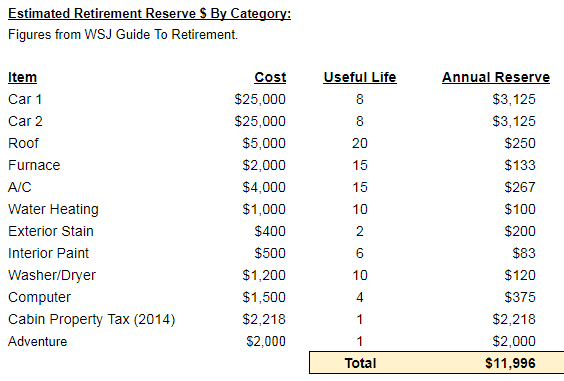
Every year, we divert the first $12k of our Safe Withdrawal Rate to a standalone “Retirement Reserves” account in Capital One. In the event any “unexpected” expenses come up during the year, we simply transfer money from that fund to our checking account to cover the bill. So far, so good, and we’ve been fortunate that the reserve has been sufficient to meet any unexpected expenses through the first 7 years of our retirement.
d) Family Assistance / Charity: Do you have parents or a child who may need your financial assistance during your retirement? Don’t naively assume they’ll be fine and exclude them from your cash flow plan. If there’s any possibility that you’ll be supporting someone you love, build it into your numbers. If they don’t need it, you’ll have a surprise to the good, and that always beats the alternative. Consider helping your children when they need it most, rather than making them wait for an inheritance. It’s rewarding to see your children benefit from a much-needed boost, but also a delicate balance of independence vs. entitlement. Think about what you want to do, and build in some buffer to allow yourself to help someone in need. The same goes for charities. Are you planning on tithing in retirement? Is there a charity you’d like to help with ongoing support? Build it into your numbers.
e) Inflation: Way back in 2019, I wrote Inflation: The Silent Killer of Retirement. Inflation had been tame for years when I wrote that article, but it didn’t stay that way. When you lay out your cash flow to age 95, add in an inflation adjustment by category to ensure you’re factoring it into your plans over time. Make sure your portfolio is properly diversified and includes Investment Options To Protect Against Inflation. Finally, make sure your spending estimate includes some discretionary spending that you can cut back on for a few years in the event of stagflation, or below-market returns combined with above-average inflation.
f) Long Term Care Expenses: We all face the risk of LTC expenses, and the only options we have to mitigate that risk are to either buy LTC insurance or choose to self-insure (note: if you don’t make a decision, you ARE choosing to self-insure). If you’ve decided to buy insurance, it’s simple to capture those in your cash flow model. Self-insurance is less obvious. If you’d like to capture this expense, I’d suggest you consider subtracting the present value of your future LTC costs from your Net Worth when calculating your Safe Withdrawal rate. Alternatively, you could hold investments to cover your potential LTC costs in a separate account, then exclude those when calculating your SWR. Either way, make sure you’ve thought about your risk of LTC expenses and factored them into your plan.

Question 3: How Will You Spend Your Time And Stay Fulfilled?
A common mistake many folks make when planning for retirement is to focus primarily on the financial issues. Money is “only” a tool, and most folks find that achieving their financial goal doesn’t, in and of itself, lead to happiness in life (did you know retirement increases the probability of depression by 40%?). Your challenge, as you approach retirement, is to decide what type of life you want to build for yourself in retirement, then use your financial resources to help you achieve the life that brings true contentment.
Successful retirees have learned that the non-financial elements are critically important and should be addressed with the same rigor as the financial elements. When you retire, you’re not only losing your paycheck. You’re also losing the following benefits from work, and you WILL struggle if you haven’t considered how you’ll replace them:
- Purpose
- Structure
- Identity
- Relationships
- Achievement
As I was approaching retirement, I was curious why some retirees had a smooth transition, whereas others struggled (only 32% of retirees reported a smooth transition). Based on my research, I discovered the most significant differentiators between happy vs. unhappy retirees. There is a direct correlation between how much planning a person does before retirement (including the non-financial elements) and the resulting transition. The more time you spend thinking about the non-financial elements, the smoother your transition will be.
I’ve written dozens of articles on the topic, and it’s the primary focus of my book. I struggle to boil the entire topic down to a summary, so I’ve decided to include a bullet list of relevant articles. If you take nothing else away from this article, please recognize the importance of answering Question 3 before you retire.
Your homework assignment: Pick at least two of the following articles and read them as you prepare to answer this critical question for yourself:
- The 4 Phases of Retirement
- Introducing The 90/10 Rule of Retirement
- Freedom For Fido – A Story of Finding Purpose in Retirement
- I Am Rich And Have No Idea What To Do With My Life
- The 10 Commandments of Retirement
- Shining The Light on Retirement Blind Spots
- 7 Hidden Traps of Retirement
- Purpose, Motivation, and Life Aspirations
- 3 Levels of Retirement Readiness: Where Do You Stand
Conclusion
In summary, the three questions you must answer before you choose to retire:
1) Do You Have A Reliable Cash Flow Plan?
2) Have You Accounted for Healthcare and Unexpected Costs?
3) How Will You Spend Your Time And Stay Fulfilled?
Will these three questions really determine 99% of your retirement success? Who knows (it did catch your attention, though, right?). Regardless of the actual percentage, there’s no doubt in my mind that these are the right questions to ask as you approach retirement (I think my old boss would be proud 😉).
More important than the questions are your answers. If you’re not comfortable answering them yourself, this is one area where it pays to hire an expert to help.
Spend the necessary time to answer the questions well.
Your retirement success is riding on it.
Your Turn: If you’re already retired, what other question would you encourage a soon-to-be retiree to ask themself? In hindsight, which of these questions are most important? If you’re not yet retired, which question concerns you the most? Let’s chat in the comments…
Well said, as always, Fritz. Retirement has been the best phase of a life that has been very rich through every phase, so far. Answering those three questions are the keys to living well, with purpose.
Money is fungible. I don’t understand why anyone would pull money out of their portfolio to create a reserve account at a bank and forego portfolio returns for bank returns (usually means 0%, when you read the fine print and factor in fees). You’ve got the money, optimize return and get it out when you need it…..but you have to recognize the need (unexpected expenses) in your cash flow plan.
Allen, sometimes the comfort of sleeping well at night is worth the sacrifice of a bit of return. For the record, I don’t keep my reserve in a bank, I keep it in a Money Market Account (Capital One 360), which reduces the opportunity cost of the holding since it pays a more competitive rate.
The one caution I’d have with your approach, “…and get it out when you need it.” What is your plan if you have an emergency immediately following a severe market downturn? A bear market is one of the biggest Sequence of Return Risks you’ll face in retirement, best to include a strategy to hedge that risk as you answer the questions. Thanks for your comment.
Thanks Fritz. What I will do in that scenario is use funds from our cash/FI bucket since we use the bucket method to manage our portfolio. Also we just got our roof replaced for $50K ! quite a bit higher than article suggestion.
I was about to ask for referrals on that $5k roof price. Where can I get that?
For me personally, I see a direct correlation to one’s success to question #3 based on one’s personality type. I wonder if you’ve touched on that while doing your research and you see a difference in success based on the different personalities. It would be interesting to know from your research out of the 32% of retirees that reported a smooth transition, what were their personalities. I’m one year into my retirement and I can honestly say I have not given much thought to the non-financial elements to define the success of my retirement. I’m not struggling. Maybe year two of my retirement I will feel differently. I’m an introvert, so I’m extremely happy not having a schedule or a plan for my day/week and the thought of doing whatever I want, when I want is pure joy for me. Would love to hear your thoughts.
Great question, BeachLife. I’m sure there is a personality component that has some correlation to transition success. I touched on it a bit in The 4 Paths of Retirement (https://www.theretirementmanifesto.com/the-four-paths-of-retirement/), you may be interested in that one.
As for your own journey, at one year you’re likely still in the honeymoon phase. Most retirees I’ve talked to don’t start struggling with “Phase 2” until ~18 months. Perhaps you’ll avoid Phase 2 entirely, as ~15% of retirees do. For more on the 4 Phases of Retirement, click here: https://www.theretirementmanifesto.com/the-4-phases-of-retirement/
Thanks for stopping by, I hope you’re able to continue to experience “pure joy” for years to come!
“Estimated Retirement Reserve $ By Category’ . These numbers from the WSJ book are almost 20 years out of date. You could easily double and in some categories triple these estimates.
Funny, I noticed that too as I wrote the post. Fortunately, I put in a reserve for 2 cars, when the reality is we’re driving FAR fewer miles than during our working years, so the reserve for the second car has served as a bit of an unintentional inflation hedge. I agree with you, however, that the numbers should be updated for anyone approaching retirement today. Thanks for the keen eye.
I came here to comment about those numbers. For perspective, I just dropped $20K and $15K on roofs for 2300 and 1600 sq ft houses, and got quotes ranging from $8-12K for a replacement heat pump AC which covers both furnace and air conditioning in your example. Amusingly, a new 17″ HP laptop runs $600-900. I got mine for $600 on sale at Sam’s Club. And yes, a new car will run closer to $50K after fees and taxes.
You’re so right that healthcare costs are the big wild card in retirement. At least now they’re way more predictable since I’m on Medicare with a supplement Plan and have very little out of pocket cost beyond the premiums.
Yes!!! outdated!!!
Hi Fritz, so great to read another article from you. I would agree that those three questions, along with your explanation of them, will get you a long way towards being ready for retirement.
I’m 12 years into retirement now, and was fortunate enough to have come across your blog when you started. As you know I’ve read everything you have written, and your blog as been a tremendous help to me in thinking through the various aspects of retirement. I appreciate the enormous amount of time and effort you have put into the retirement manifesto in an effort to help so many us.
Like you, I pulled the pin at 55. Reading through your articles helped bolster my confidence at the time that I really was on the right track. So far things have worked out beyond my wildest expectations, in large because I read your stuff and really thought through the points you were communicating. What a great ride it’s been, thanks for leading the way!
31, your loyalty to my writing never ceases to amaze me. As for giving me credit for things “working out beyond your wildest expectations,” I suspect there’s far more to your successful retirement than the words I write in this little corner of the internet. I appreciate the loyalty, as always.
Don’t underestimate your impact on the people you write for Fritz. Ideas, concepts, coaching, and mentoring can become an incredibly powerful thing over the years.
Thanks Fritz, I enjoy reading the posts and doing some thinking about these matters. While I have been retired for three years, reflection and analysis is always in order given that change is a constant. One question I would add to the mix is, “Given my transition to retirement, where do I want to live?” This is a highly consequential matter with significant financial implications. Further, doing the necessary decluttering and preparing one’s home for sale is a time consuming and emotional laden experience.
Fritz~ Your stuff is ALWAYS on target!!!! I love the idea of sleeping well at night is worth the sacrifice of a bit of a return. Having an emergency fund, identifying your consistent income and tracking your expenditures (monthly and yearly) will keep sleeping well at night, which is worth more than you can imagine.
Hi Fritz,
Love your work & have given your book to many friends & family.
I am still a bit away (7-10 years), relatively comfortable that the financial side will be ok. I am a single parent (with a bit to go), I was wondering if you have come across any good resources about solo retirement (once my child is reared & living her own life). I have a rough plans around slow travel etc in my go go years but have a concern about doing it solo as opposed to in a group if not with a partner.
Thanks
I agree that the money has to be figured out first to be successful at retirement. And I agree we all need to find our little “p” or big “P” purpose to end up happy. What I have struggled with is the age old advice of retire “to” something instead of “from” something
I find work takes up so much space and so much mental energy that it squeezes out the time to explore. To find what fulfill you takes time. Exploration is needed. I think it is totally fine to retire not knowing the answer of what “it” is.
I think a new retiree just needs to commit to trying new things until they find their fulfillment. The retirees that fail are the ones waiting for inspiration to find them. You need to chase it. Take the responsibility to keep trying new things. Leaving work can allow you that time and energy to find it
Where can I find that 5k roof.i want one
Ha Ha!!! Wishfull thinking!!!
You can contribute to an HSA up until the month you turn 65. You do not have to stop contributing 6 months before you turn 65. I see this mistake often, and it needs to be corrected.
Thank you!!!!! Love hearing your updates.
Fritz, I’m surprised your annual reserve only assumes 8 years of life for your cars. Your other estimated timelines seemed reasonable, but this one seemed a little off to me. Love the article! I just retired from the Air Force and am enjoying the retired life in Wisconsin.
Fritz, Good stuff here in this article and from what I have seen on your site so far as a newbie. Concepts are expressed clearly, important when you are talking about personal finance and investments. Some concepts I wish I had been exposed to about 10 years ago when I retired at 55. I was fortunate that I had educational and work background in finance, investments,planning and business management and applied that to my own retirement as if it was a company The part I whiffed on was coming up with a better plan for where and how to use my 50-60 hours of found time weekly. While the first 2 years were spent dealing with personal issues, once that was addressed, I found I needed more mental stimulation and to fill time. Since I always did my own investments that became my focus, beating my own prior returns and getting into income investments. I was fortunate that I was asked to join some non-profit boards, do some consulting and did some volunteering helping out older seniors in my neighborhood with taxes, picking up groceries, etc. Once my wife retired then we started traveling but its not year-round. I would add that it is important to emphasize not only income planning but tax planning. One of the biggest myths many run into is that their taxes will go down in retirement. Then they find out that the various tax deferred vehicles are all loaded up and Uncle Sam wants his piece. Not only is an income plan important but getting good tax input so you use Roths, backdoor Roths, and balance out where you take money from sequentially. The old adage about letting your deferred income run as long a possible does not always work. While I worked in various business functions and always did my own taxes, I found that getting CPA input was very valuable. It is very rare that even well educated or experienced laymen have the up to date knowledge to address current tax law and its impact on income distributions. It is not hard to mess up and end up with a liability you did not anticipate and wont like.