
There’s a story behind this story, but I’m going to save “That Story” until the PS at the end (don’t miss it, it’s golden).
With that disclaimer, let’s get started.
A long time ago (2017, to be exact), I came across an article about how to become a 401(k) millionaire. Soon after I read it, someone who knew that I had achieved the same “401(k) Millionaire” milestone asked me to write my story as a guest post on their blog.
I took a chance.
I accepted the offer.
Though I was a bit nervous about the transparency, I decided to take the plunge. I had fun writing the article, reliving memories from my early career, and digging out some cool pics and documents from my career. The entire article is included below. (If you’d prefer, you can click here to see the original article, which came out on January 20, 2017). The title of that article?
“How I Became A 401(k) Millionaire”
The photo up top actually came from that original post (thanks for your permission, J$).
The article went viral and was read by over 100,000 readers. It was shared on mainstream media websites and was my earliest “Big Success” in blogging. The exposure led to early growth on The Retirement Manifesto, and I thank all of my loyal readers who have been with me ever since.
Fast forward.
A few weeks ago, I came across that post again.
I took another chance.
I decided to reach out to J$ (see “That Story” in the PS at the end). I asked him if he’d mind if I shared the original guest post from his website directly on The Retirement Manifesto’s pages as a new post.
Fortunately, he said yes.
I smiled, and today I’m republishing my “once viral” story, word for word and in its entirety, on this page of my blog. It feels good to “bring it home.” (Note: dead links in the original post have been deleted.)
Note: A special shout-out to J$ I love you, man, and the FI world isn’t the same without you. Thanks for your permission and (more importantly) for giving me that big break early in my blogging life. You’re a role model for thousands of people, including me. I respect you for what you’ve done and for what you’re doing now.
Without further ado, here’s the story…
How I Became A 401(k) Millionaire
[Hey guys! If you ever doubted the power of a 401(k), this should help remind you again 😉 My man Fritz from The Retirement Manifesto stops by today to share his own story (and love!) for his 401(k), and this might just become my new default article to send to future haters! It’s brilliant!]
*******
A few weeks ago, J$ shared a CNN article on “401(k) Millionaires” over on his Rockstar Forum. When I replied that I, too, was a 401(k) Millionaire, he invited me to tell my story, and I agreed to do so in complete and transparent detail.
Learn from it, apply the lessons, and you, too, can become a Millionaire!
The 9 Keys to Becoming a 401(k) Millionaire
The CNN story on becoming a 401(k) Millionaire cited 5 keys, of which I followed every last one, as well as 4 others I’ve learned throughout my life. I will be telling my story using all 9 of these steps, and will show you how they have helped my wife and I become 401(k) Millionaires ourselves.
Key #1: Start Young
On July 5, 1985, I started my first “career” job. At 22 years of age, and just one month out of college, I was pleased with my $21,500 starting salary. During my orientation, I signed up for our “new” 401(k) plan, and contributed from my very first paycheck.
Unfortunately, I’ve lost track of my exact 401(k) contribution %’s early in my career. I believe I started at 6% (don’t give up that employer match!), and I gradually increased it through the years. As I became more knowledgeable about personal finance, I got much more aggressive in my contributions.
I’ve been contributing 15% or more for at least 2 decades now, and max out my 401(k) every year. I’ve never taken any money out of my 401(k). Invest it, and forget it.
My daughter just started her first “real job” as a police officer, and we taught her these “First 6 Steps To Financial Wealth” . Before she received her first paycheck, we set her up with a Vanguard Roth and a Capital One savings account. We’re teaching her the lessons we learned early, and I’ve no doubt she’ll see the benefits of “starting young” as she goes through life.
Key #2: Crush It Early
While a lot of folks focus on “Frugality” as a key to wealth creation, a much bigger lever is to maximize your earning potential. Early in your career, go “above and beyond” to create your professional reputation. You only get one chance to make a first impression, and it’s never more important to impress the right people than in the first few years of your career. When “the right folks” notice early, you’ll be naturally propelled in the first decade of your career, and much better positioned for lifetime advancement and wealth creation.
I was fortunate to impress some of the “right” folks early in my career, and was offered my first promotion within 18 months. A bit of luck always helps, and the reality is that my promotion was driven by the closing of the plant where I was working, and my company’s desire to keep me in their employment. I’ll never regret going “above and beyond” in those first 18 months. It saved my job, and I gained a promotion in the process. Almost everyone else I worked with found themselves unexpectedly unemployed. I was one of the lucky ones, but I also worked hard for that opportunity.
Moving from an “internal” Customer Service role to an “external” Sales Role, I saw my salary increase to $29,800 with my first relocation to our Dallas, TX sales office in December 1986. In 1988, I received (earned?) my second promotion, this time from “Sales Trainee” to a full fledged “Sales Representative” with another relocation (this time to Atlanta, GA) and another salary bump.
To give you a sense of what “Crush It Early” looks from a salary perspective, here’s a history of my first 6 years in Corporate America (FYI: these were the days of stagflation, with high inflation, 15% mortgage rates, and much higher annual salary increases than today):
| Date | Salary | % Increase | Comment |
| Jul, 1985 | $21,500 | n.a. | Yay, My First Job! |
| Jan, 1986 | $23,300 | 8.4% | My first raise! |
| Jul, 1986 | $25,100 | 7.7% | My boss, taking care of me |
| Dec, 2986 | $29,800 | 18.7% | My first promotion!! |
| Dec, 1987 | $32,200 | 8.1% | |
| Apr, 1988 | $35,700 | 10.9% | My second promotion! |
| Apr, 1989 | $38,500 | 7.8% | |
| Sep, 1989 | $41,500 | 7.8% | Job grade bump (competitor wanted me) |
| Sep, 1990 | $44,100 | 6.3% |
Within 5 years, I had doubled my salary through hard work, making positive impressions, and having a competitor pursue me (unsolicited, but I listened. After careful consideration, I told my boss about the offer, and received a nice “mid-year” retention bump as a result).
Every time my salary increased, my wife and I took a portion of the increase and nudged up our 401(k) contributions before we ever saw the money.
Our Net Worth in 1988: $9,996.73
Looking through my files for this article, the earliest 401(k) statement I could find was from June 1988. At this point, I had been in my career for exactly 3 years. I had been married for less than a year, and my wife and I were $3.27 short of the $10k mark in my 401(k), as demonstrated below:

When we got married in 1987, my wife began work as an Executive Assistant. Knowing we wanted her to be able to be a “stay at home” Mom when that time came, we increased my 401(k) and set up some ACH transfers to mutual funds, resulting in us saving the equivalent of 100% of her paycheck.
This allowed us to avoid getting used to her income, as well as the mistake of getting into obligations that required her pay for expense coverage. When we adopted our daughter in 1994, my wife simply “retired” (at age 31, lucky girl!), and we cut back a bit on our savings to keep our take home pay constant.
From 1987 to 1994, our 401(k) balance increased from $10k to $59k as a result of that decision, and set us on the path toward our eventual “401(k) Millionaire” status.
Key #3: Seek Opportunities For Exposure
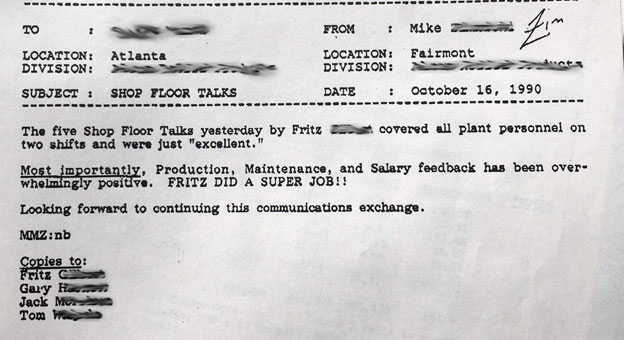
By 1990, I started getting more involved with a broader communication effort around the organization. One of those initiatives was to visit our plants with a “commercial update”, providing our plant workers a report from the “front lines” on what was happening with our customers and marketplace. I was 27 years old, and giving presentations to a room full of shop floor personnel.
Seek opportunities! The effort paid off with even more folks starting to recognize me as a “young guy with potential”, and my reputation continued to grow:
Keys #4 and #5: Get Out Of Your Comfort Zone (and Find A Mentor)
After 15 years in Sales, I was getting restless. I had a strong mentor who ran one of our larger plants, and I had some excellent career discussions with him in my mid-30’s. He kept an eye out for me, and within a short amount of time I had moved from a commercial role into my first “plant job”, planning the production & scheduling of a large operation.
That experience later led to opportunities for career advancement into national and global management roles, and I’m sure I would have never made those advancements without breaking out of the “sales track” which I had been on for 15 years.
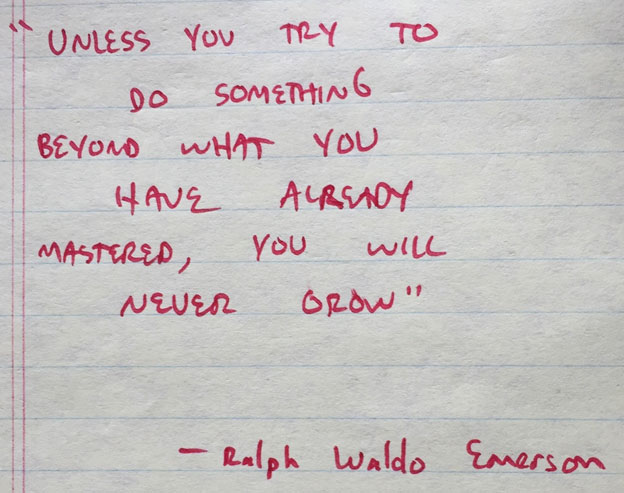
Ironically, looking through my career files for this post, I found a note I had written to myself at the same point in my career when I had decided to “branch out”. Looking back, I had no idea how significant the quote would become:
Key #6: Watch Out For Fees
Fortunately, my employer had chosen Vanguard as their 401(k) provider, and I was rewarded with a low cost 401(k) plan that had excellent investment options. My employer also continued to improve the plan over the years, with expanded investment choices and continued low fees.
If you don’t have a good plan, I would still encourage you to participate in your plan. At a minimum, do not give up the employer match. It’s free money, and the 50 – 100% “return” you get from your employer’s match offsets any high fees and poor investment choices you may have in your plan.
Review your plan now, and if you’re not maximizing your employer match, increase your contributions before your next paycheck!
Key #7: Max Out Your Contributions
As my salary continued to increase, we continued to increase our 401(k) contribution. If I received a 3% raise, for example, I’d increase my 401(k) contributions by 2% in the month the raise took effect.
Our take-home pay would increase by 1%, and we’d feel like we had a bit more money. More importantly, our 401(k) investments increased on a compounding scale. We did that every year, until we hit the limit that I was allowed to contribute to the plan.
We still do the “mental gymnastics”, but we now (since we’re maxing out the 401) use external mutual funds and ACH transfers to capture the increases in annual savings %’s.
Key #8: Live Frugally
As my salary increased over the years, the strategy of increasing my contributions at the same time we received a raise helped avoid lifestyle inflation. I’ve seen many, many co-workers increase their living expenses as their salaries have increased, and I suspect most of those are not yet 401(k) millionaires (or any millionaires for that matter).
My wife and I have always lived below our means, and I firmly believe that’s played the biggest role in becoming a millionaire. We’ve always been generous, and have contributed annually to our church and charities of our choice. [Editor’s Note: And also to projects your blog friends put on! Thanks again for the financial boost to our Community Fund :)]
We also only pay cash for our cars, and of course drive them right “into the ground”. Today, at 53 years of age, my wife drives a 2011 Hyundai, and I drive a 2010 Nissan. We could both be driving newer and fancier cars, but why? Our cars get us where we need to go, and they keep our expenses down. Keep up with The Jones?? Please!
We recently downsized our home in preparation for an early retirement, and are now ENTIRELY DEBT FREE. As my dad used to tell me early in my career:
“It’s easy to become wealthy. Just spend less than you make, and do it for a long time.”
Key #9: Automate Your Savings
For the past 31+ years, I’ve automated my savings. Starting WAY back in July 1985, when I had my very first paycheck automatically directed into my 401(k) which hasn’t stopped since. Automating those savings has “forced” us to live frugally, below our means.
We Officially Become 401(k) Millionaires!
For years, our 401(k) balance inched, ever so slowly, “Northward”. It wasn’t too exciting for the first 10 years, and we pretty much ignored the growth. Starting in 1992, I began tracking my Net Worth (if you’re not doing that yet, start NOW!). I now have 24 years of annual Net Worth data, in a nice little spreadsheet that shows us what we’ve accomplished.
Pulling from that data, you can see the progression of our 401(k) balance through the decades:
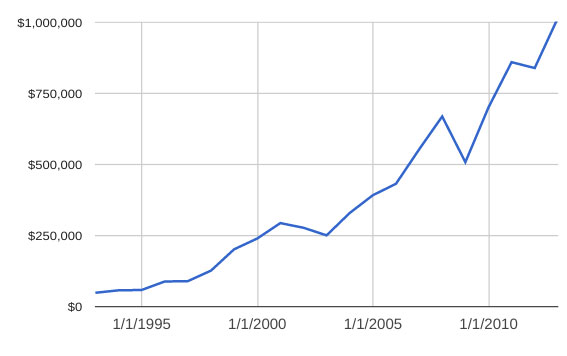
In March 2013, we officially crossed the $1 Million mark in our 401(k). After decades of diligence, we can now officially say: “We’re 401(k) Millionaires!!”
In Conclusion…
There you have it. The 9 steps that led me to becoming a 401(k) Millionaire:
- Start Young
- Crush It Early
- Seek Opportunities For Exposure
- Get Out Of Your Comfort Zone
- Find A Mentor
- Watch Out For Fees
- Max Out Your Contributions
- Live Frugally
- Automate Your Savings
Apply as many of them in your life as you possibly can, then give it time. Do it right, and you’ll find yourself among a very small minority of folks who will have realistic opportunities to retire at an earlier than “normal” age.
My wife and I plan on heading out for extended road trips in a 5th wheel within the next 18 months. We’ll be 55 years old, and will never have to work another day in our lives. We’ve not done any crazy extreme “frugal” living. We’ve lived well, we’ve traveled the world on vacations, we raised a daughter (and paid for her college!), and we don’t feel we’ve sacrificed while on “The Journey”.
Learn from our experience. With time, and a bit of luck, someday you can also be a 401(k) Millionaire!
******
Fritz is a commodity trader with a large multinational corporation, with his eyes on achieving an early retirement in 2018. He writes about personal finance and his preparation for retirement at The Retirement Manifesto, and can also be found on Twitter (@RetireManifesto) as well as on Facebook (facebook.com/TheRetirementManifesto).
P.S. “That Story” (The Story Behind The Story)

Fritz here, back in the modern world of 2026, adding a final section to the original article, to tell “That Story,” starting with the photo above. J$ (pronounced “Jay Money”, the guy on the right) was one of the original Rockstars in the personal finance blogging world. He was known for his trademark Mohawk, loved by all, known for his random acts of kindness, and the epitome of “cool” to the personal financial blogging world I had recently joined. He had the biggest blog on the planet and was really, really skilled at building community. That photo was taken at FinCon2017, by the way, which I’ll touch on shortly.
J$ was a true legend. And then something amazing happened.
At his peak, he stepped away.
He now runs a charity giving away free clothes to the homeless in his area. He recently did a rare podcast on So Money, filling in the world on what he’s been up to, and writes an occasional article on his original blog, Budgets Are Sexy. Don’t be surprised if he doesn’t write for 6 months, he’s off doing better things – like using FI to be home raising his kids, and collecting/organizing/distributing donated clothes for the needy.
I have immense respect for the man.
The Story Behind How The Original Article Happened
Ok, so J$ was cool and had one of the most popular finance blogs in the world. But how did that lead to me writing my guest post on his blog?
You need to know this first: J$ also ran an amazing forum called Rockstar Finance (now dead, no link). It was the best forum I’ve ever been a part of.
It was where all of my best blogging friends hung out. A lot.
We had transparent online chats about everything related to blogging, FIRE, personal finance, etc., and we became friends. We encouraged each other, and we shared everyone’s work with the world. (remember that sentence – it’s important to the story, as you’ll see shortly).
We all went to FinCon together in 2017, and I wrote about the experience in detail here. (I included a Money Nerd Directory in that article, with links to a ton of my friends’ websites at the end of the post. Sadly, most of those links are now dead (the average blogger lasts less than 2 years, according to ChatGPT). It was a special time.
Now that you understand “The Community,” it’s time for the rest of the story.
The Question That Started It All
One day on the Rockstar Forum, J$ posted the CNN article about 401(k) millionaires and asked if any of the community members had achieved that milestone. I replied that I had, and he asked if I’d be willing to write a guest post about it.
I was blown away.
I was, sincerely, a peon at that stage. My blog was only a year old, with only 700 email subscribers (if we’re curious, we’re approaching 20k now, thanks to all of you!).
“We shared everyone’s work with the world.”
As mentioned earlier, it’s important to understand the culture of the time. J$ was the model of generosity and regularly spread the word about everyone’s work. He ran a popular newsletter, Rockstar Finance, that highlighted the best blog articles from the week prior.
It was a badge of honor to “Get Rockstarred”.
For J$, it was natural to invite me to write a guest post on his huge blog. For me, however, it was humbling to have the Rockstar himself, J$, giving me (the new kid) a huge opportunity. I’ve never regretted that I grabbed hold and ran with it.
And the post went viral.
I’ll be forever grateful to J$ for that opportunity and the community he built, and I’ll always have fond memories of those days.
And now you know, the story behind the story.
PSS: In honor of J$’s life of “random acts of kindness,” I’m going to start a small experiment. I’ve decided to share one guest post a month, based on the best article I’ve read in the prior month. The first one was Dan Haylett’s “Your 12 Good Years,” and I’ve already got a killer post lined up for early May. I hope you enjoy the experiment…
Your Turn: Are you a 401(k) millionaire? If so, which of the 9 keys resonates most with you, and why?
we became 401k millionaires in our early 60’s. The ones that stick to me are:
Seek out opportunities
Max out your 401k contributions
Automate savings
Get out of your comfort zone.
Congrats on reaching the milestone, Bob. I can’t argue that the four you point out are key. Thanks for the first comment today!
I got there this month! A month shy of my 50th. For me it is a combo of start early, live frugally and find a mentor! As mentors go my folks don’t model good behavior, so people like Fritz, Clark Howard and Carl Richards filled that void. I remember reading about Fritz in USA Today and thinking I can do it! Thanks Fritz!
This Month!! Congratulations on reaching a key milestone while you were still in your 40’s (thank you, Mr. Market!). Too funny that you saw the story in USA Today, glad to hear it inspired you. And, I’m honored that you consider me a mentor (sorry about your folks).
thank you mr. market for sure! as my wife reminds me, I’m bound to lose the second comma temporarily, but I’ll just need to trust and know that it is all possible. between me and my two siblings we got my folks to a tenable place, but in many ways their experience was also a great teacher.
At 2 million now, have always maxed out. The 401K. Have also been blessed with generous company matches 10% of my salary, which this year alone would be almost $30,000. Started right after I finished school at 26 am 53 now will retire at 57.
How awesome!
1, 2 & 8 are IMO the keys to building a fortune in today’s world. Discipline, foresight and frugality win the long game.
Ok, I’ll admit that I had to scroll back up through the story to check which ones those were. (Hey, I wrote the story 9 years ago, give me a break). 😉
Hi Fritz and Jackie!
First, I note you always use “our” 401(k) in your post. Love you for that!
Love Mr. Emerson’s quote. So very true. I once drove to San Diego from KC for a new job….one that I really did not know all the nuances or expectations of the job. I remember Carol saying that she admired me. I asked, in surprise, why? She stated that “you don’t really even know you will know how to accomplish what they expect of you”. I replied that I was looking forward to learning something new, that I would acquire a mentor and figure it out. That led to a big career change for us! Fear can stop real progress, you know?
Lastly, your Dad was very correct in how to become wealthy. ESI. Grow your career, save more than you spend when young, and Invest it wisely. We did not buy fancy cars when young either. Now we can afford just about anything on wheels. For us, we would much rather give to the unsheltered and those less fortunate.
Keep up the great work Fritz!
Jackie, love your charity and your soft heart for dogs!
God’s blessing to all of you, Steve
Steve, love the KC story, I felt the same way for several of the promotions I accepted. As you said, you do “figure it out,” and the learning that comes from those types of moves is priceless. And yes, my Dad was “very correct” about a lot of things. I miss that guy…
PS – Thanks for the shout-out to Jackie. I can’t begin to describe how proud I am of her and what she’s built with Freedom For Fido!
Thanks for sharing, Fritz! I think your original article was one of the introductions to the FIRE movement for me. I really miss Rockstar Finance. It was a great source for finding new and different voices. I was sad when it was sold. It was never the same after J$ left, but I’m glad he was able to walk away and pursue his other rewarding goals.
“I really miss Rockstar Finance.”
You and me both, Rebecca. Those were special days. Cool to know you saw that original article “way back then,” it feels good to bring it “home” to my blog! (it was also fun touching base with J$ to ask about it, I miss that guy).
I miss Rockstar Finance too 🙂 It was one of the most rewarding projects I’ve ever been a part of. So cool to see it back in the light for a bit today!
I am a 401k millionaire too! I never made more than $85k, and that salary was in the last 6 years of my career before I retired (early)! I was working part time when the 401k plans were first introduced. I have always been a saver, so naturally I signed up, but not really understanding what this plan was all about, I started educating myself by reading Money magazine and watching CNBC. As I changed jobs, I never lost sight of where my 401k funds were (so many people do), and quickly rolled them over and got them invested in an aggressive portfolio. As my salary increased, so did my 401k contributions. I tried my best to max out my 401k (plus the catchup), and was successful a few times, or came close, the last 10 years before I retired. When I decided to retire (early), I’ll never forget my manager’s reaction and he looked at me and asked me if this was the best financial decision lol. No one would ever know I was a multi millionaire and I would have it no other way. In addition to my 401k, early on I started a taxable account, and made monthly automatic contributions (that’s what I’m living off now), and I when the Roth was first introduced, I opened a Roth IRA and made a one time max contribution, and continued with those annual contributions in whatever amount I could. On a side note, I know many people don’t like paying fees to get investment advice, but not everyone is an expert in the market, or has the time to spend studying the markets, so the fees I paid were well worth where I am sitting today. I am a firm believer that you can’t get anywhere if you are too conservatively invested, so I initially invested in an aggressive portfolio (I can stomach the market volatility) and I’m still invested aggressive today.
Beach life, congrats on reaching the milestone and retiring early – proof that it doesn’t take a “mega-salary” to get it done. For the record, I agree with you that for many people it’s money well spent to hire a professional to help you manage your finances. While many are capable DIY’ers, there are many more who would benefit from the “investment” in having a professional on their team. Thanks for stopping by.
If find it interesting that “Get out of your comfort zone” has in recent years been replaced by “College students need safe spaces.”
Wonder if that means there will be fewer 401k millionaires in the future.
Great point, Mark. I tend to shun safe spaces….just sayin’. Wink.
Hey, I remember when this post first came out! I was actually a little taken aback, but then motivated by this one. I ended up becoming a 401(k) millionaire in April 2021, about 4 years after your post. Thanks for the nudge with this, Fritz!
PS J$ is the man!!
PPS Who’s that weird-looking guy with his face covered up trying to rock a Mohawk with J$?! 😉
Jim, great to hear from an old friend who I first met at that infamous FinCon17. You and I are probably the only two still blogging from those days. Haha.
Re that PPS – my lips are sealed. Wink.
The gang’s all back today!! lol… so fun to read and remember.. Much love to both of you 🙌
Thanks for sharing this Fritz, and for all you have done to help others increase their financial literacy. I committed to reading, watching, or listening to at least one blog post, article, or podcast on personal finance every day many years ago, and this simple practice has made all the difference. Even a superfical understanding and knowledge base helps make better informed decisions. I retired in 2022, and despite a monthly drawdown of $6000, my net worth today is 10% higher than it was when I retired. As Albert Einstein (purportedly) stated, “compound interest is the eighth wonder of the world, he who understands it, earns it; he who doesn’t, pays it”.
Kevin, I love your “one per day” mantra, great approach! I’m pleased that mine was the post you read today – wink. And yes, the strong markets have been a true tailwind in our early retirement years. Like you, my balance keeps growing, and I’ve heard the same from many others who retired in our timeframe. We’re fortunate, and blessed.
Thanks for sharing on so many levels. One, it is great to read some of your earlier work. Your voice has remained consistent after all these years – which makes sense, since it’s YOUR voice. It’s also great to hear how you got your start in the blogging world and just how generous many in this space were and continue to be (like you). Lastly, I love how you included all the mentions about your career progression; it often gets overlooked.
It reminds me of one of my favorite blogs that I’ve ever written about my own career path and how much of it was about being “good” but also being “lucky” – Great stuff!
https://forthenapos.com/is-it-better-to-be-lucky-or-good/
My voice may be the same, but I can assure you I can no longer hit the high notes I used to hit when I sang tenor…
Thanks for sharing your post, fun to see what folks remember about their careers. Definitely an element of being both lucky and good. Thanks for stopping by, my friend.
This was a great article and when I look back, I recall a couple mistakes along the way. The one I regret the most was cashing out my first employer’s retirement account and so then needing to start over at age 30 which was luckily around the time the 401k came out. With a good 6% match and 10% of my own money I essentially made it to that early retirement with $700k in 2012, which in today’s dollars would be over $1m at 3% inflation. I was blessed with a good boss, who had no problem allowing me to stretch my “comfort zone” and increase my own personal “worth” to the company with various 1-2 week training courses almost every year. Increasing this “worth” allowed me to in most years get a raise equal or better than inflation. Part of the rest of the equation is staying in the same house for 40 years and improving that house early on in that ownership. It turns out that equity in that house compounds much the same as your 401k if you keep it up over the years and add to it. Then when you retire, if you downsize, or even go to fully renting, you unlock the other portion of your hidden wealth in that real estate. It turns out that 40 years of home ownership was worth almost the same as my 401k and I lost essentially nothing in LTCG to unlock it by keeping every receipt of improvements I had made over the 40 years and doing most of the work myself.
“It turns out that 40 years of home ownership was worth almost the same as my 401k…”
Fascinating addition, FD. Unfortunately, I had to move 10 times during my career, so I felt (as you did with your 401k), that I was “starting over” each time. At least I had that 401k to pull me across The Starting Line!
Hopefully, you were renting during that time because home ownership can be destructive to your NW with lots of moves. I am renting now in retirement and the nest egg from the home sale more than covers the rent.
Really helps to work for a company with a generous match. For the last 12 years I’ve been able to max out my contributions and receive a dollar for dollar match including on the over 50 catch-up.
Generous, indeed. You’re a fortunate man, glad to see you’re taking full advantage of it.
The memories!! All flooding back!
I distinctly remember talking to you about this and how excited I was to share it with the world. To this day one of my favorite guest posts for sure and was elated to hear you wanted to resurrect it 🙂 Thank you for doing so, and for the kind words at the end! Stuff like this makes me miss the whole community and what we were building back in the day. Which is probably why I still can’t “let it go” after all these years – even after I initially sold it!!
I’ll have to pop into FinCon again one day and give everyone hugs… a lot of new people on the scene but still a good chunk of veteran bloggers too – now including you! (fun fact – sometimes I still think of myself as a newbie blogger because even when I started there were handfuls before me and I remember thinking I was late to the game lol).
Love you lots man, and thanks for sharing the behind the scenes here w/ this post. I never knew any of this and it warmed my heart this morning as I sip my coffee and reflect on those days… How blessed we all are.
J$’s In The House!
Man, this really DOES feel like those golden years! Thanks for stopping by, J, and thanks again for all you’ve given the community over the years. Great touching base with you after all these years, and seeing your killer Mohawk in the comments. Keep crushing it, my friend.
I started reading your blog about 2017 – might have even been one of those 700. Never got my 401k to millionaire status. I didn’t have access to one until 2002 and only reached a bit over $800k when early retirement was sort of forced upon me in late 2019. Definitely maxed out the last 10 years or so. Probably biggest thing was holding on with full contributions through 2008/2009 and being generally 80-90% equities. But I did max out our Roth IRAs since the early 90s and they crossed the million threshold in early 2022 (included only 60k in conversions). Start early, stay committed and hang on!
I also remember reading David Copperfield in my teens – “Annual income twenty pounds, annual expenditure nineteen [pounds] nineteen [shillings] and six [pence], result happiness. Annual income twenty pounds, annual expenditure twenty pounds ought and six, result misery.” Mr. Micawber
I’ll take a Roth Millionaire over a Traditional 401k Millionaire (mostly pre-tax) any day, Kevin G. Well done. Kev!
My wife and I crossed over at age 64. Never underestimate the power of the 401(k) pre tax benefits. Both of us together shaved off over $60k per year from adjusted gross income just due to the pre-tax contributions. Now we rolled them over to an IRA. In addition to the max out 401(k) contributions, it’s good to fill up a ROTH IRA each year and put excess into an after tax brokerage account. With the great standard deductions given to married seniors now (almost $50k per year), the first $50k we pull out of the IRA is money that was never taxed and will never be! We are delaying SS until age 70. Using all 3 accounts strategically keeps our taxes down. Thanks for the article Fritz.
Well played, Steve. Love the strategy of delaying SS to allow lower-tax access to all of those pre-tax funds! In my early retirement years, I was doing aggressive Roth conversions. This year, Ugly Aunt IRMAA kicks in, so I’ll have to do some math before deciding how much I want to convert. I’ve also started withdrawing some Bond Ladder rungs in my IRA. Nice to have various levers we can pull in retirement to minimize the tax bite!
Fritz, I highly recommend a book that I bought 2 months ago and obtained a wealth of knowledge about retirement taxes and “Aunt IRMAA.” Seems she’s not so bad after all – more of a nuisance!. The book is on Amazon and called Tax Planning to and through early retirement by Cody Garrett and Sean Mullaney. It’s a great read even well into later retirement years. Check it out – it opened my eyes for sure.
Surpassed a million 3 years ago, roughly a year after my retirement which occurred at 65. The nine principals you mentioned were followed by my husband and I. His retirement is worth over a million as well. Lots of diligence since we raised three kids, putting them through college with minimal loans. At one time we had three in undergrad studies for 5 semesters. We ate alot of spaghetti!
3 Undergrads, and $2M between you and your husband. You’ve won the game, Joanne, trust you’ll find true joy in your retirement years (with spaghetti only when you want it – wink).
Depending on where a person lives and/or lifestyle, 1 million may not cover expenses for a 30 year retirement.
Examples: living in a “high cost of living” location like NYC or San Francisco plus owning a second home.
I couldn’t agree more, Richard. No where in the article do I suggest $1M (pre-tax, to boot) would be sufficient for retirement. Fortunately, I also contributed to a taxable brokerage along the way…
I retired in January at age 60 with $1.94 million in my 401k. My max salary through my 35+ year career was $121,000. I started investing in my 401k at age 22, never touching the money, and increasing my contributions as I could until I maxed out several years ago.
Thanks for providing another example of how it’s done, CJ. Congratulations on the achievement!
Great article, thanks for the memory recall as well.
Your career arc looks so familiar and very similar milestones along each step. Mentors have had a way to see something that we did not at the time.
I had the same starting salary in January 1985 right out of college. It must have been an HR template back then. LOL.
Crazy that we had the same salary, and similar career arc. I guess we both turned out ok, right? 😉
Thank you for all your articles, Fritz! They have helped me immensely in planning my retirement ahead. My wife and I immigrated to USA in the 90s and we started on our financial journey late after we became permanent residents in our 30s. We did our full contribution into 401K and, a few years later, added full contribution to IRA. We lived frugally, driving our cars to the ground as you put it, but not skimping on travel since that is a passion that my wife and I share. I started calculating my net worth every month in a spreadsheet since 2002. My wife retired early after we had our firstborn with health issues. I continued with full contribution to my 401K and both our IRA accounts (except for 3-4 years when we could not contribute to IRA). When I read this article, I checked my spreadsheet to see when we became 401K – IRA millionaires. It took 15 years to reach our first million! Since then, it has accelerated. I guess it takes money to make money and living well under our means. All the steps you mention above resonate with me … they helped my career and in preparation for my retirement. I am financially independent now, per my calculation, but will continue to work for a couple more years just out of abundance of caution.
PN, congrats on a job well done. Don’t let that “couple more years” of work drag on any longer than absolutely necessary, it’s time to enjoy life – you’ve earned it!
“Fifty thou a year will buy a lot of beer. The future’s so bright, I gotta wear shades”. You were not that far off when that song was popular.
We were never able to become 401(k) millionaires because we did not have corporate jobs, but we are IRAs millionaires. We started early on to save more than we spend, and did automate DRIP investments. We also started our 3 girls IRAs very young when we employed them to help out on my locum free lance side business, as I tried to grow my professional income and take on 2-3 assignments with overtime and calls each week as much as possible and put the extra income all into our retirement. Today I can proudly say that not only my wife and I are 7 m net worth millionaires, but our 3 daughters are on their ways to be as well. Great thanks for your tireless work, keep it up. God bless.
AC, nothing better than seeing the habit transcend the generations. Great job for you and your wife, I suspect your daughters will be in the same boat before they know it.
Love this Fritz. Your Ralph Waldo Emerson quote is gold. And your dad sounds like mine.
Dana
Dana, your Dad was obviously a great man. 😉 And yes, I love that RWE quote, couldn’t believe I kept it in my “Work File” for all those years, amazing to read in retrospect.
Yes we became 401k millionaires at around ages 45 and 46. We retired at ages 56 and 57. This month we are sitting at $1.9 + our home just appraised at $460k. Driving a totally paid by cash car into the ground sounds familiar. Paying off our mortgage by age 40 was a goal we made in 1989 when we bought our first home at ages 21 and 22. Always maxed out contributions and when second spouse started working when the kids started school we saved 75% of that salary. Which now is a nice cash account which is what we are currently living on. We always contribute 10% to our church. Made max contributions to health savings and retired with ~$100k for our future medical expenses. We have traveled extensively in the US mostly in the west where we live. Lived modestly, avoided things like buying boats or a vacation home etc. We raised 2 kids and helped them each with down payment $ on their first homes. We both worked jobs that had a pension program when we started and will have that $ also when we decide we want to start them. Probably in our early 60s. I read Millionaire next door in my late 20s and recommend everyone read it! Our story reflects yours Fritz in many ways. Great article.
“Our story reflects yours Fritz in many ways.”
Indeed it does. I was thinking “Yep, yep, yep” through almost every line of your story. Thanks for sharing another example of how it’s done. Congratulations on playing the game well.
I hit the $1M 401k mark in early 2025 at age 54. More importantly, my total investments and great advice from the Retirement Manifesto is allowing me to retire on May 15 at age 55! I think I first found this site in 2019, but it’s a bit fuzzy since I’ve gone back and read many articles from before then. Fritz, I feel like I’ve followed a similar journey to FIRE (only I’m 8 years behind you), so your example has always been very relevant to me. I was already well on the financial path to FIRE by the time I found your work, but it has been a huge help in preparing an orderly career exit and making plans for the next chapter. It’s still scary stepping off the “cliff of irrelevance” and heading into the unknown, but it’s also exciting. I hope I can rock retirement half as well as you have! Many thanks!!!
“…my total investments and great advice from the Retirement Manifesto is allowing me to retire on May 15 at age 55…”
Age 55 – now that sounds familiar! Thanks for the compliment, but we all know it was really your commitment to investments that allowed you to get to the Starting Line at such a young age. Congratulations, and best of luck with the transition into the best years of your life! I’ve no doubt that with the planning it sounds like you’ve done, you’ll rock retirement as well as anyone. Enjoy the journey, and thanks again for the kind words.
Great article Fritz and fun to learn the history behind your story. We followed a similar trajectory with our 401Ks. I would add one more key to your list. If you get a surprise windfall of money, whether it is $500 or $5,000, invest at least 80% (or use it to pay down your mortgage) and use the rest for a little fun money. That way you still enjoy the surprise gift but are building your retirement wealth. We were able to pay off our house early by doing this and doubling payments when we could.
Cheers to the retirement years!
Just got to thinking about my previous comment and, while it is a great suggestion that served us well, it does not really fit with the 401K theme of your post. Sigh. I should never comment on blogs after 6:00 p.m. Thanks again for another great post.
No need to apologize, Marian. Your comment was a great one, and a very solid piece of advice. We did exactly that along the way with our annual bonus (which was something I could divert into the 401k, so there was some overlap between your suggestion and the article, after all!).
I too “Got Rich Slowly” and have hit the magic million a few times since 2017, but am resigned to be a $900k+/- anaire. Life just gets in the way. Successfuly retired since 2013.
“Got Rich Slowly,” indeed. BTW, Life getting in the way is a good thing. Isn’t that really what it’s all about? Congrats on 13 years of retirement, I’m 5 years behind you and loving every minute of retirement.
Thanks for everything you have shared and done for this community. I found you a (few) years ago when I was researching the Bucket Strategy. I followed you closely! I had to go back and look, but we reached 401k (IRA) millionaire status in 2022. I retired in 10/25. My husband was able to retire much earlier with a good pension and a great healthcare plan. We have always been frugal, paid off the house early and I maxed out 401k and Roth contributions for years. Thanks again for everything you do!
It’s a solid game plan, Fritz, and one I followed also. Especially 2,3 and 4 that all lead to maxing out your income. Over a 38 year career I rose from summer intern to GM and VP of the entire division. And my compensation rose from X to 24X during the same period. And that only happened because I crushed it early, grew big time exposure to senior leadership and stepped way out of my naturally timid comfort zone. I got to testify before the Senate and House in DC, something that would have terrified me had I not made it a point to become really good at public speaking, got to represent my corporation on television, in op eds and on YouTube. And weirdly, it was all a ton of fun for a formerly shy wall flower. And naturally with extreme engineering skills and good presentation ones, I just kept getting promoted and paid more. As usual I always agree with everything you write!