If given the opportunity, what could you learn from those on their deathbeds?
It seems a morbid topic, but I encourage you to take a moment to overcome your initial discomfort.
Death is a difficult topic, but isn’t there a lot to learn from folks in their final moments?
- What are their regrets?
- What are they most proud of?
- What would they have done differently?
- What lessons can we learn to improve our lives?
Fortunately for all of us, a hospice doctor has shared those lessons in an excellent book, “Taking Stock – A Hospice Doctor’s Advice on Financial Independence, Building Wealth, and Living a Regret-Free Life.” (Amazon affiliate link – I’ll get a small commission at no cost to you if you order with that link)
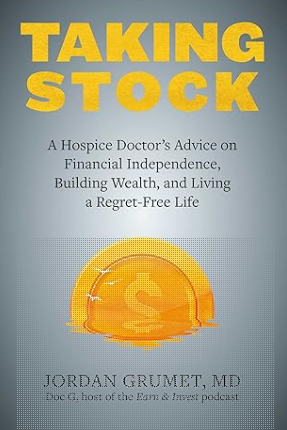
Jordan Grumet, MD, affectionately known in the personal finance community as “Doc G”, is the host of the Earn & Invest podcast. More importantly, he left the world of “traditional” medicine to focus on hospice work and providing comfort to those in their final days. His passion for the work shows through his words, and the wisdom he’s gained offers a rare insight.
Today, we’re taking a look inside the covers, and discussing the wisdom shared by Doc G.
I recently completed Jordan Grumet's excellent book, Taking Stock, and today I share my thoughts in a new book review. Share on XTaking Stock
This book caught my attention when it was published last year, and I immediately added it to my “To Read” list in my Goodreads account. I read the book in late March and, as soon as I read the introduction, I immediately knew I would write a book review on it.
This is a book you should read.
It’s a rare glimpse into that narrow sliver of time between life and death. The time when hospice is called in to assist in the difficult final preparation for death. A time that’s hard to talk about, and awkward for most of us to experience. A time in which Jordan Grumet, MD, spends his professional life.
When you read his words, you realize it’s not as difficult a time as most of us expect. As Dr. Grumet shares his stories, you realize it’s a time of deep reflection. A time of reviewing your life; a time to reflect on what you did well, and what you wish you would have done differently. It’s interesting to see how priorities change when you know you’re going to die. As Doc G reminds us, we’re all dying. It’s a helpful reminder to challenge the priorities in your life while there’s still time.
When I first heard of the book, I expected it would expand on the infamous work of Bronnie Ware, a hospice nurse who I featured in my article Top 5 Regrets People Have On Their Deathbeds (And How To Avoid Them). I was correct in a sense, but Dr. Grumet goes much further.
Taking Stock (affiliate link) is a broader view into the thinking of those in their final days. It’s a fascinating glimpse into thoughts that really matter and provides deep insight into how we can apply the lessons learned to improve our lives today. Grumet has organized the book in an easy-to-read flow that addresses the critical issues, the ones that go far beyond financial concerns and comprise the true keys to a successful life. At the end of each chapter, Grumet includes a concise two-page summary with specific action items for you to take to apply the lessons from each chapter into your life. It’s a good format and encourages application.
I’m not going to spoil the book for you, so I’ll just summarize the points that most resonated with me. Trust me, there is much to learn in this book beyond the highlights presented below. Part One is titled “What Financial Experts Get Wrong About Life – And Death” and contains the following three chapters.
Chapter 1: Money Is Like Oxygen
- Grumet’s strategy of “flattening Maslow’s Pyramid,” which presents his recommendation that we should seek all levels of the pyramid in parallel vs. approaching them in sequence. It aligns well with my philosophy of living a balanced life and focusing on developing all of your spokes.
- Wealth should be viewed as a tool, rather than a goal. The theme of having financial goals was visited several times in the book, along with the common reaction of disappointment when you achieve your financial goals only to realize that achievement doesn’t bring true joy and happiness. Rather, you need to find the Purpose and passions to define your life and view wealth as a tool to help with this quest.
- The value of redefining “enough” with a life review, in which you “attempt to find meaning and achieve resolution of one’s life.” It’s a reminder of the importance of being intentional, seeking your Purpose, and embracing “the climb” (a concept I found interesting and of value).
Chapter 2: Work Doesn’t Stop When You Retire
- A discussion on the FIRE movement, and why the nirvana of achieving early retirement often doesn’t last.
- A good introduction to the various paths of FIRE (e.g., Slow FI, Coast FI) and the merits of each.
- The “Money Mind Meld,” Grumet’s name for the fault of focusing on achieving a targeted wealth number only to discover that’s not the true path to contentment. The following quote is a powerful section of the chapter:
“We are failing to consider the key life concepts that have the most impact on day-to-day emotional well-being, self-actualization, and life satisfaction: purpose, identity, and connection.”
The remainder of Chapter 2 digs into each of these concepts and was my favorite part of the book.
Chapter 3: The Art of Subtraction
- The importance of living in the now and avoiding the “once I have enough” syndrome.
- The importance of balancing delaying gratification while also enjoying the journey.
- I enjoyed the discussion on “Opportunity Cost” and the reminder that giving up opportunities to enjoy the now is also an opportunity cost.
- The chapter’s title refers to Grumet’s recommendation to find things that don’t enhance your life and find a way to remove (or diminish) them.
- A reminder that FI/wealth isn’t a goal, but a lever that should be used for the art of subtraction.
Part 2 is titled Many Paths to Financial Independence and includes the next three chapters…
Chapter 4: The Parable of the Three Brothers
This was a new parable for me, and a creative way to illustrate that there are numerous paths one can choose for their life. Depending on your personality and preferences, your path will likely resemble one of the three brothers or, perhaps, components of each.
Rather than reveal the secrets from the book, I’ll leave the details out of this review. I do applaud Grumet for recognizing that, by definition, “personal” finance is personal and there’s nothing wrong with that. The important thing is to be self-aware and recognize the strengths and weaknesses of whichever approach you choose in life to minimize the regrets he so often hears from his hospice patients.
Chapter 5: Putting Your Financial House in Order
No book including “advice on financial independence” in its sub-title can omit the ever-important “money chapter,” and Chapter 5 is exactly that. I like Grumet’s approach of highlighting that financials aren’t the important part of this book, but rather a tool that will “go far in giving your the space, time, and freedom to pursue that which is most meaningful to you.” That said, the chapter does a good job of summarizing the key financial considerations and is appropriate to include in the book.
Chapter 6: It’s Time We Talked
Grumet has had the unfortunate opportunity to deal with families who weren’t prepared, and this chapter contains the lessons others have learned the hard way. With his expertise as a hospice doctor, Grumet is well-suited to address the many pitfalls that arise when someone becomes seriously ill on short notice, as well as to provide advice on the critical steps to take while you still can. The chapter includes:
- Suggestions on how to initiate “the talk” with your parents (or children).
- Key financial legacy documents you should have in place.
- The importance of completing an ICE (In Case of Emergency) Binder.
Part 3 is titled “The One Thing the Dying Wish They Had More Of – Time” and includes the final two chapters:
Chapter 7: Time Perception Arbitrage
Grumet’s opening sentence to this chapter is worthing of repeating here:
“Although we may not know exactly how many seconds or minutes we have, we are apportioned a limited amount of time on this earth from the day we are born to the day we die. There is no getting around this immutable truth.”
Powerful writing, and an example of the value of this book. Grumet focuses the chapter on techniques he recommends for “hacking” your perception of time, including some concepts that were new to me (e.g., Parkinson’s Law). There’s a lot in this chapter and I found it difficult to summarize, but there are some ideas that are worthy of your consideration. That said, for some reason, this chapter didn’t resonate with me as strongly as the rest of the book. Regardless, his inclusion of a chapter focusing on the importance of time is spot on with the overall theme of the book, and I highly recommend the book in spite of the lack of resonance I felt with this one chapter.
Chapter 8: Investing Tips From A Hospice Doctor
While the latter part of Chapter 2 was my favorite part of the book, Chapter 8 was my favorite overall chapter. Grumet does an excellent job of challenging you to “invest” in things far beyond money. The focus of this chapter is his advice on how best to invest in yourself to achieve a life with few regrets. Rather than spoil the best chapter in the book, I’ve listed below the subheadings from the chapter to give you a taste of the areas covered:
- Change is for the living, not the dying.
- The power of reconciliation.
- The courage to fail.
- Living in the moment.
- Chasing false gods.
- The difference between investment and speculation.
- Investing tips from a hospice doctor (with suggestions for how to invest in yourself, education, other people, children, physical and mental health, and the market).
A powerful chapter, and alone worth the price of the book.
The One Thing I Wish He’d Included…
When I talked with Doc G a few weeks ago, I mentioned I was halfway through the book and was thoroughly enjoying it. I mentioned that I was planning on writing this review and he said, “Make sure you include suggestions on things I should have done differently.”
Your wish is my command, Doc. Wink.
On a serious note, the one thing I would have liked to have seen was a discussion on the question of “what happens after death.” Yes, it sounds morbid, but it’s a question all of us ask at some point in our life, and I suspect it’s a common theme with his patients. Including a chapter on the spiritual reflections of his hospice patients would have rounded out his emphasis on the importance of conducting a “life review,” which should include reflection on your spiritual priorities. As I wrote in Vitality – Lost, I recognize spiritual issues can be “thin ice” for a writer, but a chapter on what hospice patients talk and think about with regard to spirituality would have been a strong addition to the book.
That said, I thoroughly enjoyed this book and the challenges it presents. It’s a great book to encourage you to reflect on your life and identify what changes you should consider to live your best possible life. With his background as a hospice doctor, Doc G provides a perspective that you’ll be hard-pressed to find anywhere else. Most importantly, he’s thought through the lessons he’s learned and provides sound recommendations for how to apply them in your life.
Great stuff, and well worth the price of the book.
Conclusion
“Taking Stock – A Hospice Doctor’s Advice on Financial Independence, Building Wealth, and Living a Regret-Free Life.” (Amazon affiliate link) is a powerful book and I highly recommend it. It offers the unique perspective of a hospice doctor who spends his time caring for folks in their final days. More importantly, it includes suggestions for the living on steps they should take now to live their best possible life and avoid regrets in their final days.
When folks are near death, they realize what’s important and what they wish they’d have done differently.
Thanks to Dr. Grumet, we can learn from them and apply their lessons in our lives today.
If you apply only one lesson from this book, you’ll find it well worth the cost of the book.
5 Stars.
Previous Book Reviews:

An excellent cover for this book Fritz!
As a hospice volunteer, I will add this tidbit for all of us as we age. Maintain your sense of humor….as you age, your body WILL hurt in places that it doesn’t when you are 50. Embrace the hurts and please don’t constantly complain to friends and family.
One elderly patient I admire has a very positive attitude while laying in her bed doing nothing but thinking and eating meals. She is blind and very hard of hearing. I sit so close to her to visit, it is almost uncomfortable (at the beginning of our relationship). We are now friends and I look forward to the times when I feed her lunch. Staying positive while laying there waiting for our Creator to take her to her permanent home motivates me to remain humbles and grateful for my own good health. I just imagine how I would react to not being able to read, not watch TV, not see my grandchildren….she can’t even hear her kids when they telephone her! She never complains about her pain or life, just sad that she can’t do much. I admire her. I want to be her when I get really old and unable to do enjoyable activities any longer. What do you readers think about her?
Love to all and Happy Easter! One of my most reflective and grateful days to remember Him. Steve
Steve, thanks for adding that valuable tip on maintaining your sense of humor, I agree that your patient is an excellent example of the attitude we should all strive to maintain. We’ve all know elderly people who never lose their sense of humor, and I believe it’s something you can intentional retain if you so choose. Thanks for volunteering with hospice and sharing your personal experience. Say “hi” to your patient from me during your next lunch, and let her know her story is making an impact on this writer. Happy Easter, indeed.
I have a friend in her late 80’s similar to your patient. I think they are just waiting to die. Silence about their situation isn’t a sign they are content. Perhaps they are just resigned to what has happened to them. Some people don’t want to burden anyone with their true feelings. If they aren’t speaking about it, you don’t know. In no way would I hope to be like them. It seems like a horrible end of life, but accepting your situation instead of staying angry seems preferable. My friend had a good life (professor, intelligent, active, happily married). I can only hope in her dark, quiet world she lives in those memories.
Thank you for the book link. I think we all fail to plan what happens when we pass on.
I just got the e-book for $1.97!!!!
I read this book last year when it first came out. It really changed my focus on living more in the moment and knowing when enough money is enough. Hence, after working this past year as my “last” year, I announced my retirement last week and I’m counting down the days to July 7. I’ve been following your blog for several years. Your practical approach to all aspects of retirement planning helped us to come to the retirement decision while we are still young (I’m 56 and my husband is 58 and he’s been retired already for 2 years). We are looking forward to the next phase of focusing on ourselves, our family and finding new purpose. I personally want to volunteer in the Smoky Mountain National Park and have already filled out an application.
I just called the library and put this book on hold. Told me I will have it by Monday! Get to keep it for 3 weeks.
Dave Ramsey would be proud…..
God speed to you and Jackie! Steve
BTW…one recommendation I can share with anyone interested in “recreational fiction” type stories…Please Google author Daniel Silva…the main character in his series is Gabriel Allon. Fun reading in suspense form. Also learn a lot about world geography as a bonus! 🙂
Thank you for writing a review of DocG’s book.
Question1: I imagine that each chapter would start with the story of a particular patient that exemplified the theme for that chapter, is this book’s contents heavily filled with these retold real-life case studies? Would the book title as well have been, “the collected stories from hospice patients, regarding their final advice to us on financial independence, etc…” ?
Question2: Fritz’s recommendation for another chapter, “what happens after death.” There could also be a mortal version of this chapter as well — “what happens to the family after the patient’s death.” What was the ultimate outcome (positives and negatives) of the decisions/actions of the patient’s final days on their surviving family members (regarding financial independence and a regret-free life) ?
Chapter 1: Money Is Like Oxygen (Absolutely NOT, money is like “FERTILIZER”)
Chapter 2: Work Doesn’t Stop When You Retire (Absolutely – you can stop working on your last breath)
Chapter 3: The Art of Subtraction (Do this only in the second half of a lifespan, short term SUBTRACTIONS in the early years can lead to very few options in later years)
Chapter 4: The Parable of the Three Brothers (It is the journey and not the destination)
Chapter 5: Putting Your Financial House in Order (Absolutely – the worst of you reveals when you are hungry)
Chapter 6: It’s Time We Talked (You came to this world orderly; therefore, you should leave it orderly)
Chapter 7: Time Perception Arbitrage (Again, life is a journey and not a dentition)
Chapter 8: Investing Tips from A Hospice Doctor (Investing in: Financial Security, Relationship Stability, Health and Humanity)
“what happens after death.” (There will be transformation from “I” to “Humanity”)
Fritz – thanks for the book recommendation on a tough topic that we’ll all face at some point in our lives. Bought it – thank you. Something else we can chat about next time we’re together over coffee at your plush resort – Happy Resurrection Day – Give our best to your loved ones.