After years of saving during your working years, what changes should you make to prepare your finances for retirement?
When your paycheck stops, you’ll depend on your portfolio to fund your living expenses.
It’s a scary shift in the way you use your money.
Moving from the “Accumulation Phase” to the “Decumulation Phase” is a strategic shift in your goals and requires planning as you prepare for retirement.
In the words of a recent email from a reader, it’s enough to make your head spin.
With her permission, I’m sharing Rachel’s email and providing these “10 Steps to Prepare Your Finances For Retirement” as a response.
If you’re planning for retirement, today’s post is for you.
If you're preparing for retirement, here are 10 steps you need to take to position your finances. Share on X
10 Steps To Prepare Your Finances For Retirement
Moving from the “Accumulation Phase” to the “Decumulation Phase” is likely the biggest financial change you’ll go through in life. It raises some questions:
- How should I modify my portfolio in preparation for retirement?
- What changes need to be made to build a “Retirement Paycheck?”
- How do you go about the process without being overwhelmed?
- How do you know you’re really ready to retire?
The significance of the change can cause anxiety, as illustrated by the following email I received from Rachel (emphasis added by me), which was the trigger for writing today’s post.
Hi Fritz!
I’m a long-time reader and fan of yours and we are coming up on our retirement very soon. Just an idea for a blog post…
In all the planning, my head is spinning, as I try to allocate the appropriate investments into the “right” cash flow buckets (bucket strategy), while at the same time optimizing tax structure for all those investments, while at the same time accounting for social security amounts and taxes, while at the same time figuring out the best plan for Roth conversions. It all becomes a bit overwhelming and has me wondering just how important this level of detail really will be! There must be a more streamlined way of making all of these calculations to optimize all of my accounts and amounts!
Specifically, I would love to see a blog post where you talk about how you managed to reconcile all of these strategies in unison (without losing your marbles in the process lol).
Best regards,
Rachel
10 Steps To Prepare Your Finances For Retirement
Below are the 10 steps I suggest to Rachel and anyone approaching retirement as you prepare your finances for retirement. It’s an exhaustive list and will require some time to implement. Start early (1-2 years before retirement), and work through the steps methodically. Ideally, they’d be taken in the sequence presented.

1. Start Building Cash
In our working years, most of us were comfortable carrying a 1 – 6 month “Emergency Fund” of cash. In retirement, however, most folks should have a larger cash cushion (1 – 3 years is recommended) to mitigate the Sequence of Return Risk and reduce the need to sell stocks after a downturn. Increasing your cash reserves by 2+ years of spending is a big task and will take some time to implement.
In my final 18 months of work, I reduced contributions to my 401k plan (keeping only the 6% matched) and increased our after-tax contributions to a Money Market Fund. We also directed 100% of my bonus in my last two years to the MMF.
In Step #5, we’ll evaluate your risk tolerance to help you fine-tune how much cash you should carry. For now, I’m listing “Start Building Cash” as your first priority since it takes a while and will be necessary for all but those with the highest risk tolerance.
2. Estimate Your Retirement Spending
Ultimately, retirement is a math equation.
- If Spending < Income, you can retire.
- If Spending > Income, you can’t.
It sounds easy, but how do you put numbers into that formula? (Therein lies the rub.)
As you prepare your finances for retirement, estimating your retirement spending is a critical part of the process that is sometimes overlooked. How will you know how much cash to build if you don’t know how much you’ll need each year? As I outlined in the first post of my When Can I Retire Series, we tracked every dime we spent for 11 months before I retired. Having established a firm baseline, we then estimated how things would change once we retired. The big ones:
- Since I retired at age 55, we’d have to pay for private insurance for 10 years.
- With our relocation to the mountains, the downsizing move eliminated our mortgage.
- With our dreams to travel, we had to build in an estimate for the RV, truck, and camping expenses.
- Knowing we wanted to do Roth conversions, we had to estimate the related tax expenses.
Focusing on your spending estimate early in the process is helpful since, by definition, it also requires you to think about critical retirement spending issues (health insurance, travel, taxes) that could otherwise be overlooked.
Yes, it’s a painful process.
But it’s critical.
3. Determine Your Retirement Income
With the first part of the formula in place, it’s time to turn your attention to the second. How much income can you safely produce in retirement? I addressed this in detail in the second post of the When Can I Retire Series, summarized below.
There are two main elements to consider:
- Known Income (Pension, Social Security)
- Variable Income (Portfolio Withdrawals, part-time work)
I’d suggest you focus on the Known Income first, it’s easier. Learn about Social Security Claiming Strategies to determine when to start receiving those benefits (you don’t need to finalize your decision at this point, but it’s helpful to have an idea). If you choose to delay (like me), you need to determine the portfolio withdrawals you’ll need to bridge those extra years. If you are lucky enough to have earned a pension, get updated pension estimates for various retirement dates and determine your start date for the pension.
To estimate your Variable Income, update your Net Worth Statement and subtract any assets that won’t be used to fund retirement (See line 56 in this spreadsheet for my formula, which subtracts cars, home equity, etc). The result is your “Retirement Assets” which can be used to fund retirement. If you’re still a few years out from retirement, add a few columns to calculate your projected Net Worth by future year, and copy the Retirement Asset formula to see the impact of waiting one year, two years, etc.
Once you know your Retirement Asset figure, multiply it by 3%, 3.5%, and 4% (lines 59-60) to determine a “Safe Withdrawal Rate” you can safely spend from your assets.
Finally, add in any part-time income you expect to earn in retirement. Be conservative, you don’t want to be dependent on an optimistic income and find yourself falling short once you’ve retired. As I’ll outline in Step #5, it’s best to hedge your bets and be surprised by the good vs. being too aggressive and finding yourself short after you’ve retired.
Add the Known and Variable Incomes together, and compare them to your estimated spending.
Voila. Math problem solved.
You now know if you’re ready to retire from a financial perspective. Don’t forget to spend some time thinking about the non-financial aspects of retirement. That’s beyond the scope of today’s post, but is something I write about frequently (see “7 Secrets To A Great Retirement” for an example).
It’s important, don’t overlook it.

4. Quantify “The Gap”
“The Gap” is an important concept as you plan for retirement.
Once you’ve determined your income sources in Step 3, determine “The Gap” by subtracting your Known Income (Pension, SS) from your Retirement Expenses. For example, if your estimated spending is $80k and you’ll have $30k from SS, your “Gap” would be $50k ($80 – $30 = $50).
It’s also important to realize that “The Gap” could change from year to year, especially if you’re planning on delaying your Social Security. Using the above example (and eliminating inflation for simplicity), let’s assume you’re retiring at age 63 and won’t claim SS until age 70. The gap would be $80k for those first 7 years, then drop to $50k at age 70.
In addition, perhaps you’re planning on doing Roth conversions before taking Social Security (assuming it won’t disqualify you from ACA Health Insurance subsidies.) If the $80k covers “normal” spending, recognize there will be an additional tax expense for those Roth conversions, creating a larger gap in your early retirement years.
Another “Gap” that some folks don’t consider is when you can access your retirement funds. If you’re retiring before the age of 59 1/2, make sure you include an analysis of how much money you have in your accessible after-tax accounts to “bridge the gap” until you can access your retirement funds (another reason Step #1 is so important, especially if you’re retiring early). There are some techniques to access retirement money before age 59 1/2 (such as the Rule of 55), but they’re outside the scope of this article.
The Gap, and how it changes with time, impacts how you prepare your finances for retirement.
To help visualize how things change with time, we built a simplified retirement cash flow spreadsheet that modeled our income and spending from retirement at age 55 through age 95. You can look at it here, but I would suggest you build your own (I took a shortcut with my tax calculation that I don’t like in hindsight).
A better solution would be to use Boldin Financial Planner, a robust and helpful tool to visualize your retirement cash flow over your lifetime. I’m a proponent of the Bolden software and recommend it to anyone in the planning stages of retirement. Since you’ve already updated your Net Worth and estimated your spending and income, you’re ready to plug those numbers into Bolden. I used it in addition to my spreadsheets when planning for my retirement, and recommend it to all of my readers.
It’s important to understand your Gap and how it changes over time. We’ll use this knowledge in Step 7.
5. Hedge Your Bets
Once you’ve reached this point, it’s time to step back.
Where are you being too optimistic? What have you missed? Can you get health insurance for the price you estimated, or should you add a hedge? Can you get by with that 4% SWR, or will a higher (and more risky) withdrawal rate be required?
It’s time to ask yourself about risk. How much are you comfortable with? How will you react if there’s a bear market the month after you retire? Take this free (and quick) Risk Tolerance Assessment to see where you rate on this scale:

Consider adding some hedges into your calculations if you have an average or lower risk tolerance. We estimated most of our expenses on the higher end, and it’s been enjoyable in retirement to see our actual spending come in lower than forecast.
Knowing your risk tolerance also helps you establish the size of your cash reserve and asset allocation, which we’ll discuss in Steps #7 and #8 below.
6. Analyze Your Current Reality
This is where the fun starts.
Before you can determine how to prepare your finances for retirement, you must have a clear view of your current situation. I wrote Our Retirement Drawdown Strategy a year before I retired, and encourage you to begin writing your strategy at this stage in the process (use my article as an example).
Below are two charts from the first page of our strategy, which show how I thought through the “Analyze Your Current Reality” step:

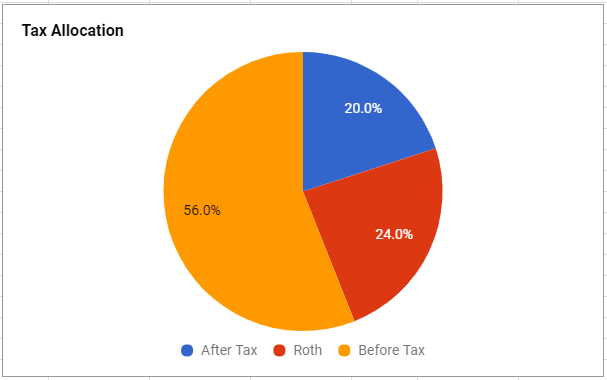
Once we had a clear view of our current reality, we identified the steps we needed to take to prepare our finances for retirement. You’ll figure this out as you work through the remaining steps, and I encourage you to add them to your strategy as you decide what changes are appropriate for you. In our case, the main steps included:
- Delay The Pension
- Do Roth Conversions
- Implement The Bucket Strategy
- Improve our Tax Location Efficiency
- Figure out Health Care Insurance
- Delay Social Security
- Several Other Items I put under “Longer Term”
Again, the Boldin Financial Planner is a great tool to capture your current state and evaluate the impact of various approaches in your Withdrawal Strategy. If you do nothing else with today’s post, I hope you evaluate that tool – it’s the best one that I’m aware of for those who are trying to figure out how to prepare your finances for retirement.
Note: If you’re curious about how our Drawdown Strategy played out, you can read the update I wrote titled “Revising Our Drawdown Strategy After 3 Years of Retirement.”, where I gave ourselves a grade for every major element in the strategy (3 A’s, a B and a B-). I’m also considering a third article in the series, looking at our Drawdown Strategy after 6 years of retirement, using the 12/31/24 data for the update. Stay tuned for this one early in 2025…
7. Design A Retirement Paycheck
One of the biggest steps as you prepare your finances for retirement is to decide what system to use to replace your paycheck. In essence, how will you fund “The Gap?”
We decided to use The Bucket Strategy, which I’ve written about extensively in The Bucket Strategy Series. The main thing I like about this strategy is the mental model represented by the 3 buckets and the peace of mind Buckets 1 and 2 provide against stock market volatility. We’re sleeping well at night, and that’s worth a lot. Here’s a summary of the three buckets:
- Bucket 1 / Cash: Short-term retirement spending (2-3 years of spending)
- Bucket 2 / Bonds: Mid-term spending, hedge against bear markets (4-6 years of spending)
- Bucket 3 / Stocks: Long-term spending, inflation protection (remainder of the portfolio)
In summary (read the series for the details), The Bucket Strategy provides a monthly transfer from our CapitalOne Money Market Fund into our checking account. Once it’s set up, there’s no need for budgeting and no anxiety about spending if we have the money in our checking account.
To use our example from Step #4 above, if your “Gap” is $50k, you’d hold $100k – $150k in cash and transfer $4,166/month ($50k/12 months) into your checking account each month. As Bucket 1 declines over the year, you’d refill it from either Bucket 2 or Bucket 3, depending on which asset class has outperformed (we use our Asset Allocation to determine our refill strategy, as I discuss here).
As your “Gap” evolves, you can resize Bucket 1 accordingly. Once Social Security starts, for example, you can reduce the amount of money held in Bucket 1 since “The Gap” will now be smaller than it was before receiving Social Security. If you get some part-time income, you can use that to refill Bucket 1. You may also want to convert your dividends to cash (vs. automatically reinvesting) in your after-tax accounts, a move we’ve made to ease the refilling process.
We’re 6 years into retirement, and those monthly paychecks continue to flow. It’s worked well for us, but it’s far from the only way of replacing your paycheck. (Watch this video from Rob Berger for an argument in favor of simply using a 60/40 portfolio).
The key elements to consider are to build an approach that provides:
- A system to automatically transfer funds into your checking account.
- A mechanism to cover “emergency expenses” without exceeding your SWR. (see Q5 in this article)
- A cushion of cash and bonds to minimize your risk of selling stocks in a Bear Market.
- A system to rebalance between Asset Allocation classes at least once/year.
The important thing is to decide and then set up a system that works for you BEFORE you retire. Regardless of the path chosen, it is critical to establish a cash buffer before your paycheck stops. Imagine a Bear Market crash immediately after you retire, and you’ll quickly realize the importance of having your protection in place before your retirement date. (There’s a reason I listed “Start Building Cash” as the #1 Step.) Selling stocks in a downturn is one of your biggest risks in retirement, and you must have a system in place to avoid that before your retirement begins.
8. Modify Your Asset Allocation To Align With New Risks
As you prepare your finances for retirement your asset allocation will likely need to be modified as you approach retirement.
Why?
Your Asset Allocation should be aligned with your risk tolerance, and your risk tolerance will change dramatically in retirement. As one example, your “Human Capital” and ongoing paycheck were your buffers against a Bear Market while you were working, reducing your risk. Those will be gone (or greatly reduced) in retirement, and you’ll be far more exposed when the next bear market arrives (and there WILL be a bear market, or two, or three during your retirement). In addition, you’re now depending on your portfolio to cover your expenses, which adds additional risk.
We’ve already discussed increasing your cash buffer in Steps 1 and 7, but it’s worth looking at your Stock/Bond mix to see if you’re too exposed to stock market volatility.
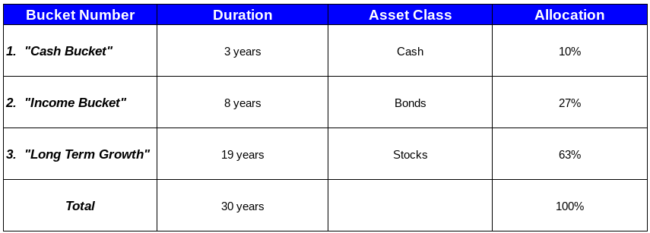
The Bucket Strategy automatically defines your initial asset allocation for retirement. In Your Bucket Strategy Questions, Answered!, I addressed a question regarding The Bucket Strategy and Asset Allocation which is relevant. Assuming you’ve saved 30 years’ worth of spending in your portfolio, Bucket 1 (Cash) will become 10% of your portfolio (3 years / 30 years). Your decision on how many years you’re going to hold in each bucket automatically leads to an asset allocation, as presented in the example below from that article:
You may consider adding a Bond Ladder into your strategy, which we’ve done recently. I explain the details in How To Build A Bond Ladder and feel it is a better structure for years 2-5 versus going with a Bond mutual fund or ETF, which can experience fluctuations in value based on interest rate changes. With a bond ladder, you’ll be holding the bonds to maturity, locking in the rate of return and allowing you to better predict your future income.
If you decide to use a system other than The Bucket Strategy to develop your retirement paycheck, take some time to review your current asset allocation and consider “de-risking” it before retirement. A standard “rule of thumb” (I hate those) is on the order of 60/40 stocks to bonds, but your risk profile from Step 5 should be considered as you finalize your asset allocation.
One final point, especially for those without a pension. As you’re working on your Asset Allocation, it’s reasonable to evaluate Annuities as part of your plan. The annuity payment will, in effect, reduce the “Gap” that you’re covering with your portfolio. Use Immediate Annuities to get some current estimates. For example, a 60-year-old man could get a $586/month payment for life in return for a $100k investment (a 7% annual payout rate, which justifies consideration). Annuities are typically best suited for lower-risk individuals without a base income (pension), though they could also be used as a shorter-term bridge to Social Security. (For example, if you’re retiring at 65 and want to delay SS until age 70, a 5-year certain annuity would pay $1,844/month for the same $100k investment, but would only pay from age 65 to age 70).
9. Consider Roth Conversions
An important consideration as you prepare your finances for retirement is whether to pursue Roth Conversions in your early retirement years before the dreaded Required Minimum Distributions kick in. I’ve discussed Roth Conversions in detail in The Golden Years of Roth Conversions, and would encourage you to read that article for more background.
From a planning perspective, the decision on whether to pursue Roth has a major impact in the following areas:
- Impact on ACA health insurance subsidies (if you’re retiring before age 65).
- Increased spending requirements to cover the additional tax expense.
- Potentially closing your 401k to make Roth conversions easier.
- IRMAA Surcharges on Medicare premiums (if you’re doing Roth conversions at age 63 or later).
Recognize your Quarterly Estimated Tax payments will be higher when doing Roth conversions, and ensure you’ve planned sufficient income to cover the additional expense. We also found it difficult to process Roth conversions from our 401k, so we said Goodbye To Our 401k and rolled it over into our individual IRA account to simplify the process.
As I was writing this article, I read Optimizing ACA Subsidies vs. Roth Conversions, an excellent article weighing the pros and cons of doing Roth conversions while also maximizing ACA subsidies. It’s worth a read if this applies to you.
Finally, the Boldin Financial Planner is an excellent tool for evaluating whether Roth conversions make sense. It provides an assessment of your lifetime tax expenses under various scenarios and helps make your decision. If you’re planning for retirement and haven’t yet explored this product, I strongly recommend it.
10. Implement A Year-End Financial Review
If you’re not already doing an annual financial review, it will be critical to start one in retirement. In my article “A Step-By-Step Guide For Your Annual Financial Review” I provide a detailed checklist of things you should cover in your annual review, including items specific to post-retirement years.
At a minimum, you must have a method to update your net worth, monitor your annual spending, rebalance your asset allocation, refill your buckets, and determine your Safe Withdrawal Rate for the following year.

Conclusion: How To Eat The Elephant
For my conclusion, I’ve decided to share my e-mail response to Rachel, which I wrote on November 25th. I wrote the e-mail in a few minutes, whereas I’ve spent hours writing today’s post. I’m pleased to see this article was consistent with my original response, and consider it an appropriate (and Pithy) summary of everything I’ve written above.
Your Turn: What steps are you taking to prepare your finances for retirement? Were any of these 10 items a surprise? If you’ve already retired, what advice would you give those approaching retirement? Let’s chat…
Such a terrific roadmap! Even if already retired, it makes sense to periodically revisit these steps.
Glad to get your feedback, I was wondering how my retired readers would react to this one. I agree it’s a great reminder, even if you’re already retired, of the importance of paying attention to this stuff even after retirement.
Most comments make this so complicated. I mean it’s really simple folks. If you don’t have enough to live off the income distribution, then you are not ready to become financially independent. Plan on living longer than you assume. A portion of my portfolio is dedicated to growth which I basically forget about because it’s in growth managed mutual funds. The mortal sin of taxable distributions is covered being in my tax qualified accounts. Additionally, I love, yes love, distribution’s because they grow my share accumulation compounding my share base. More shares mean’s more income distribution. Of course, I know it’s never guaranteed. I have a balanced fund that has distributed more than I have written a check for! That’s right. It
‘s returned more than I’ve bought. Yeah, it’s not Apple, Tesla, or Berk A. But I’ve never had to cannibalize my portfolio, by selling shares, to sustain my life style. No body knows the future on any company. As a retiree I’ve chosen a conservative income orientated portfolio as opposed to volitive growth. Yeah, should have, could have, would have but who knows so spare the criticism. I’m 80/ 20 with a pension and SS. Comments respected.
Thank you for this. As a person who – hopefully – has 15 months left of full time work, this will come in handy. I have been doing parts of 1, 2, and 3, so a review of the rest of the steps is welcome. I will look up all the links at the same time, so that I can put it all together.
15 months to go…perfect timing for this article! Glad it will come in handy, you’re exactly the type of person it was written for.
This is an excellent retirement planning approach and action plan, one of the best such articles I’ve ever come across, perhaps, in part because it is pretty much how we approached our own retirement planning. Keep up the good work!
“…one of the best such articles I’ve ever come across…”
Music to my ears!
Great insightful post like usual young man! 🙂
My input is to advise people of the peace that an annuity can bring. As an owner of 2 (one lifetime), having 6 retirement checks coming in is very comforting (after we draw SS). If you have all of your annual expenses covered, there really is no purpose to being in the market except to grow the legacy you may want to leave for charity and family. We are grateful to God and thankful for how our lives have evolved since my Navy retirement. We had no idea we would have planned it out how we did. Also very thankful for all the blogger’s advice we have read in the last 20 years. Knowledge is no good unless applied. That phrase was one I used often when speaking to the young sailors.
Happy holidays to all of you readers! And to Fritz and Jackie, Carol and I wish both of you (and your fur babies) a joyous and memorable time celebrating Jesus’ birth! Safe travels south to your second home.
God speed, Steve
Steve, thanks for reiterating the value of annuities. Too many people overlook them based on their (historically) poor reputation, but yours is a perfect example of when they make sense.
Enjoy your Christmas, as well. And you’re correct…we will be spending it at our second home in Alabama, celebrating an amazing birth, for which we are eternally grateful.
Fritz, I love your insights and have learned a lot from your articles. I’m also a big fan of Rob Berger. I saw you provided the link to his argument that the bucket approach was not a good solution vs a simple asses allocation mix (ie 60/40). I honestly thought his and many others have a very persuasive argument why the bucket approach is not a good answer (especially in down markets). Have you ever considered abandoning the bucket approach in light of these arguments? Just curious. I have been very happy with a simple 60/40 mix. Note I do have a 1 year “bucket” set aside in a money market but it is counted towards the 40% fixed income side. I rebalance once a year and effectively sell off winners and buy losers. Simple. Thanks again for all you do.
Asset. Lol.
Mike, you should have seen my first draft! (I had an entire section doing a “deeper dive” on Rob’s arguments, which I agree are very convincing. The article ended up being WAAAAY too long, so I deleted it when doing one of my 3-4 editing sessions). Having watched that video, and being 6 years into retirement (with less Sequence of Return Risk), I have to admit I’ve thought about changing to the straight 60/40 approach he advocates. The Bucket Strategy has worked well for me, however, and I’ve actually bought some stocks when they were down, so I’m comfortable that I can manage through his biggest argument. That said, nothing lasts forever, and I’m sure at some point as my retirement continues to mature that I’ll consider. Rob does a great job with that video, and I encourage anyone who is building (or managing) a retirement paycheck to give it serious consideration. If I ever DO change, I’ll write a post about it (I should have kept those paragraphs I deleted during my edit….oops).
Ha. Thanks Fritz. Keep up the great work. I’m 2 years in retirement and your manifesto has been wonderful. I forward it to many of my friends on the verge of retirement. Also – great job on The Retirement Answer Man’s podcast. Always nice to hear you. You and your family – Have a Very Merry Christmas!
Awesome breakdown Fritz! I was also a bit overwhelmed, but this will definitely help. THANK YOU!
Janet
You know how to eat that elephant…one bite at a time. Happy chewing!
Asset. Lol.
Took me a second…just noticed your typo in your original comment. Not sure what an “Asses Allocation” is, but don’t think I’ll go there. Correction noted. 😉
Great timing for me, Fritz. The “One more year” syndrome for me ends in 2025 (age/63 by then). I plan to migrate to part time in June through as late as December 5th, but not a day later.
I have set up the first few steps and plan to add to the cash bucket in the next two to three weeks to take advantage of this stellar year of earnings. I plan to park 3+ years in cash, currently at 2+. My next hurdle is planning for consolidation of 9 funds across three investment houses into one (Fidelity) and then considering whether to roll my Fidelity 401k’s into an IRA. I also want to build a bond ladder, not sure if/how Fidelity supports that.
One thing perhaps to note is that those of us without a pension and plans to delay SS until 70, it is ok to withdraw more than 4%. Ours will be ~5% before SS and only ~2-3% after.
Thanks again for all you do and Merry Christmas to you!
Dave, thank you for adding the comment about a >4% being acceptable during the bridge years to SS. I thought about that after I’d published my post, and recognized that was something I should have highlighted.
Best of luck defeating that OMY syndrome. I suffered from the same myself, tho I was fortunate in keeping it to only ONE more year. Like you, I drew a line in the sand, and it worked. I hope the same is true for you.
Great post Fritz! I usually do not like speculation into the future, but I think preparation on one is necessary. President elect Trump ran specifically on social security being tax exempt, and I took that to mean my retirement benefit will be 100% tax exempt rather than 15% as it is under present law. I haven’t seen any discussion on that, maybe you can work it. For me, it cuts my effective tax rate in half and appears to make a lot more bracket room for Roth conversions (even though it will still be MAGI for IRMAA purposes). Maybe just stronger reasoning to delay claiming if it passes.
Steve, like you, I don’t usually speculate on the future, and I’m not doing it now. Once policies become clear, I’ll respond accordingly. I encourage my readers to do the same. Part of maintaining a longer-term strategy is learning to avoid the “noise.” It’s noisy these days…put some ear plugs in. Wink.
Great article! Someone else alluded to the value of an annuity, and I am also one of them. Granted, they are not for everyone, but for myself and my wife our annuity provides us with peace of mind, combined with our social security. Between these two income streams, our entire monthly budget is almost covered (95%).
There is no substitution for doing the homework, as your article pointed out. Our retirement bucket strategy is 1/3 Protection (Social Security and Annuity) 1/3 Growth (70/30 U.S. Stocks/International Stock) NO bonds, and 1/3 Short Term (Cash / Money Market)
Merry Christmas to everyone!
Vince, thanks for reiterating the value of annuities. I’m sure you have great peace of mind knowing 95% of your spending needs are covered. I hope my article encourages other people to evaluate the option.
I retired 6 years ago and am now going to need to take RMD’s in 2025. Do you have any articles or advice on how to take that money out. In my IRA I have a money market, International fund, total stock market fund, and bond fund. My RMD will be around $65,000. I know I don’t need to spend the money so I will probably put it in my brokerage account (and take nicer vacations)! But, do I divide the amount among the funds, or take it from the one that has appreciated the most this year, or what if the market suddenly drops, then how do I decide! I just never gave it much thought! Any guidance is greatly appreciated and hopefully help your other readers who are getting close to RMD age. Time does go fast!
Laurel, I haven’t written an article on RMD’s to date, most likely because they’re still 9 years in my future and I haven’t put much thought into it (besides doing large Roth conversions every year to minimize the “problem” of RMD’s).
That said, my initial reaction to your question is that you should view your RMD distributions as a chance to rebalance your Asset Allocation. If you’re too heavy on stocks, take the RMD in stocks and reinvest them in after-tax muni-bonds or cash. If you’re short on stocks, take the RMD in bonds and reinvest them in stocks in your after-tax accounts. Using your asset allocation figures to help you make the decision should be a fairly easy solution to the problem. Hope that helps!
I like the step approach.
Basically; review ones financial situation
before retirement and consider the reality bs be one’s “retirement dreams”.
The only thing I would add are the phases of retirement.
The go – go phase.
The slow-go phase
The no-go phase
Each of these phases determines the annual spend outcome of one’s investments vs cash flow.
Most expenses in terms of “fun & travel” experiences will be in the go-go phase I.e 65-75 years of age.
The slow – go phase 75-85 will be less “impulsive” fun & travel experiences and more health care needs, local attractions & family time.
The no-go phase 85-95 (if one lives that long) and more likely for women than men will likely be health care/PSW/retirement home expense.
So, even though the “4%” withdrawal formula is generally considered useful, it changes over the 3 phases or st least reallocated differently.
David, great point and example of how spending (and “The Gap”) changes with time. When I did the cash flow forecast through age 95, I modeled the three “Go” phases and projected my spending accordingly. Most experts say retirement spending tends to model a “smile” curve, with heavy spending on both ends (Go-Go = Travel, No-Go = Healthcare). Great addition to the discussion.
Hi, Fritz! I’ve been reading your posts for years, and they have definitely helped me in my transition to retirement (took the plunge at 61 — 4 years ago).
The only thing I’d emphasize in what you wrote is the importance of learning about IRMAA while you’re still working. I did not, and I regret it. I should have been doing Roth conversions while still working and in my first 2 years of retirement. Once I really started paying attention, I hit 63, and it was too late, as Medicare does a 2 year look back to determine the amount you have to pay. So now, I’m trying to take enough money from my IRA to stay in the first level of IRMAA payment (times 2 because we file jointly) for the years until I have to take my RMDs, hoping I reduce the amount in my IRA enough to continue to stay in that first level of IRMAA. I know this isn’t the biggest problem in the world (we all have to pay the tax man sooner or later), but had I paid attention earlier, I could have paid the taxes while still earning, and not be trying to balance Social Security, Annuities, and eventually RMDs.
Thanks again for all of your fine posts — being a “dog mom” to 6 rescue dogs, I especially enjoy your Freedom for Fido posts!
Diane, thanks for pointing out the importance of doing Roth conversions early. As I mentioned in the Roth article linked in the post above, IRMAA is definitely a consideration once you reach age 63. As you say, it’s a “First World Problem,” but nice to avoid if you’re aware.
Also, thanks for the comment about Freedom For Fido. We’re finishing up our 154th build tomorrow! Rewarding beyond words. Thank you for taking care of those rescue dogs, you know they appreciate you (and so do I).
Also check out form SSA-44 – Medicare Income Related Monthly Adjustment Amount Life Changing Event. This form could save you significant IRMAA Medicare expenses.
Hey Fritz. Avid follower here. I plan on sending this Article to my three sons and encourage them to think about early retirement. I’m excited to dive into the Boldin planner as I like to geek out on these kinds of things.
Your information is easy to understand and has served great purpose in my retirement planning. Thank you for what you do!
Thanks for the kind words, Patti. I hope your three sons listen to the advice of their (obviously wise) Mom. Wink. Enjoy your dive into Boldin, it really is an amazingly helpful product.
One important decision early in your process is whether you will manage your own investments or work with a financial manager. There are varieties within that decision (fee-basis advisor vs full asset management vs partial, etc).
If diy where will you get you information to make decision and what investment philosophy will you follow. Also, how and to whom will you transition when the need arises (death of the spouse-manager, dementia, poor execution, etc).
If a full financial manager are you comfortable paying (about) 1% of your assets value annually to someone who may just track the market (if you are lucky). [A $1M portfolio at 4% SWR plus 1% to the manager means 20% of your total withdrawal goes to someone else.]
Whatever you choose has risks and benefits – get a deep understanding before you decide.
I spent hours evaluating investment options and made quite a few mistakes before settling on a style that suits me long term. (Retired two years now but the market has been on a tear so I don’t consider myself “successful” just yet.)
All the best,
J
Good addition to the discussion. Getting this stuff right is important. If you’re not comfortable doing it yourself, this is one area where it pays to have an expert.
Fritz,
I’m drafting a similar note for a friend of mine. I’ve added two steps in that note you don’t mention very much that I think deserve their own steps.
0. Healthcare
This deserves it’s own step and it should be done fairly early as the cost numbers will be needed in step 1 as expenses. For my friend it’s going to be the choice between traditional medicare supplements and Advantage plans. One wrinkle, our local hospital is dropping several Advantage plans next year.
7.5 Understand Tax implications
Once the paycheck is designed, then you can understand how it will be taxed. If it’s a bridge year that you are funding with capital gains, it will be taxed very differently than a year funded by IRA withdrawals. There is lots of variation in how States tax social security and pension/IRA income. If you are considering moving to a different state, looking at both state tax systems can be useful.
Amazing minds, Steve. Good additions. I touched on each in the “Estimate Your Expenses,” but you’re correct in saying these are major categories and deserve a deep dive.
I think the term “epic” best describes your “10 Steps …” process. I’ve read your book, numerous blogs, and watched various appearances on YouTube and Podcasts. I stray in my “Special Interest (retirement planning)” away from the simple to follow and implement processes you provide, but keep coming back.
Recently, I purchased another one of your books to give as a Christmas present. I suppose I look into volume pricing as I’d love to give copies of your book to multiple friends and family.
Thanks and keep up the great work!!
Epic!? I could ask for nothing more. Thanks for your kind words. Glad you “keep coming back”. And, thanks for giving away my books, much appreciated! (Too bad I’m not in charge of pricing, I’d be happy to give you that bulk discount!).
Fritz, you’ve taken what takes some people 400 pages to lay out and done it in a wonderfully succinct article. What a fabulous roadmap with room for flexibility based on personal risk tolerances, etc. I’m still 5 years from retirement but will definitely be bookmarking this for future reference. Thank you!
Did you just call my 4,000 word article “succinct?” Perhaps my longest article to date, but I did cover a lot of ground…
Thanks Fritz. So 4+ years in, all solid advice. I tapped into cash bucket only once. Roth conversions almost done (about 1/3 pre-tax, 2/3 Roth). Mostly pulling from TSP 401k, but switching to dividends paid as cash (for stocks near 52 week highs). What I find interesting is my buckets essentially match a 60/40 portfolio. Though I sleep better with cash allocation. Am I past sequence of returns? Who knows. I just know we can spend more than we do, even if my mindset remains superfrugal.
“Roth conversions almost done…”
You’re killing me. You know that, right?
Fritz, you’ve done it again! Another great, actionable post. A concise distillation of your previous “how to” posts. I retired during one of the worst years for investments. Your Bucket Strategy saved me! Although I didn’t have to dig deep into it, knowing it was there let me sleep better, and allowed me to stay fully invested for the next bull market, which inevitably came. Are there marginally better strategies? Maybe. But it’s a great baseline to deviate from.
I’m sure that Boldin is a worthwhile service. I’m a huge fan of Monte Carlo simulations to predict probabilities of success, and have used Financial Engines when it was free and later when it was available through Vanguard. I would also recommend that almost everyone should have some proficiency with Excel. Even if you have a paid financial advisor or service, a working knowledge of a few simple formulas and financial functions can be a sanity check on how you’re doing. It’s also super helpful to calculate mortgage payments, car payments and other loans.
One last thing that I would recommend, especially for folks doing Roth conversions, is to get an IRS account to pay estimated taxes. While I have taxes withheld from some of my income streams, I purposely don’t withhold enough to pay for any Roth conversions, which can vary drastically from year to year. Instead, I estimate my additional tax burden from the conversions and pay them quarterly, directly to the IRS. The website is surprisingly easy to use, and you can schedule all four quarterly payments in January when you do your tax planning. You can have the payments made exactly on the deadline dates, and they even send you a reminder in advance so that you know the funds are going to transfer. Also, you can pay by credit card. They only charge a 1.82% fee, so you can come out ahead if you have a credit card that returns 2%!